



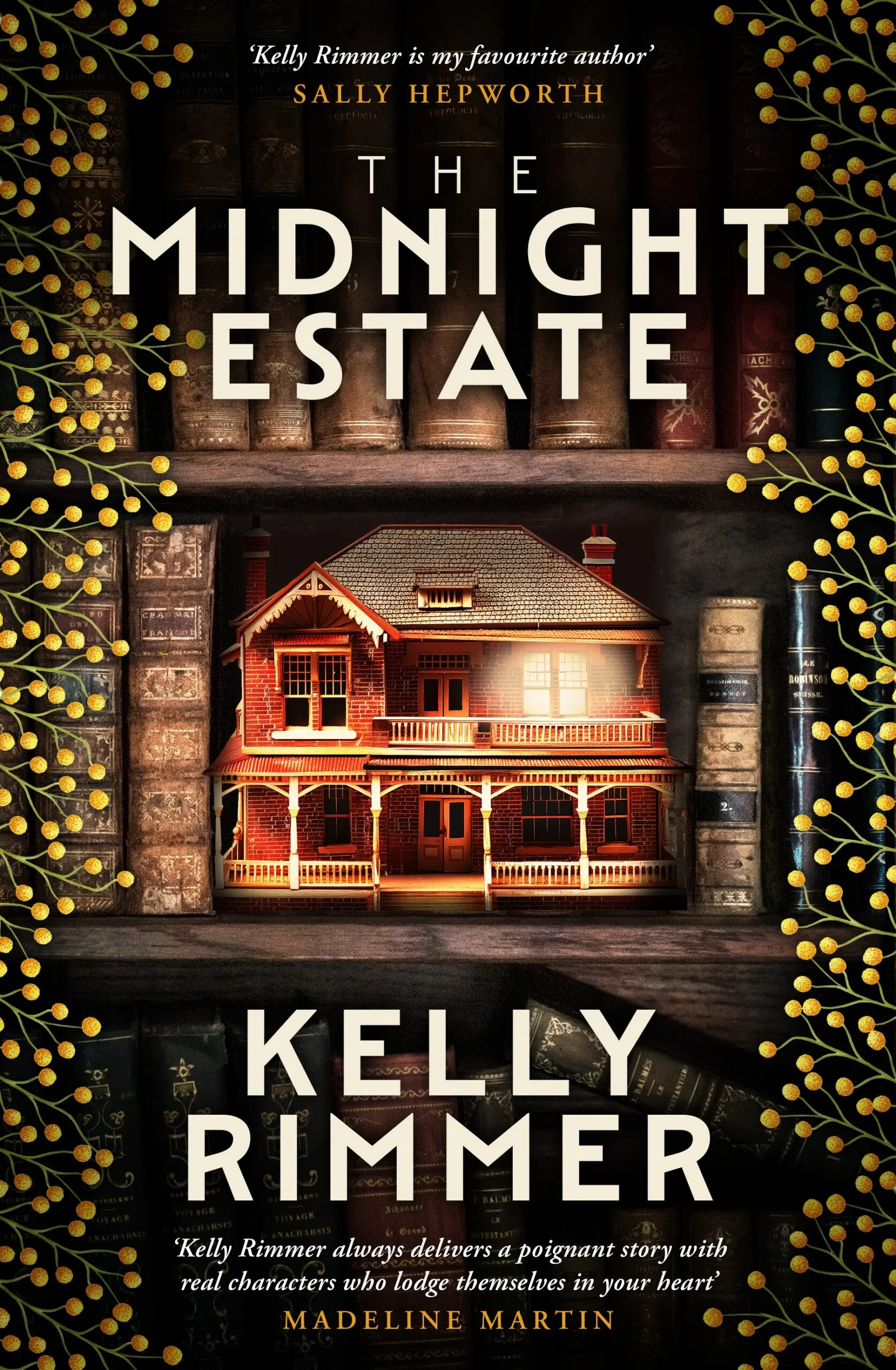
AWW: The rambling family estate, Wurimbirra, stands at the centre of The Midnight Estate. I understand you worked for a time in a heritage consultancy like one of your main characters, Fiona. Can you tell me about the process of bringing the old house to life?
Kelly: It was so fun! There are so many of them scattered around Australia, but especially around the central west. They’re like these living museums of a place and time that is gone. I didn’t really have much of an interest in history until I had that job at the heritage consultancy.
I was reading about all of these super cool buildings and these restoration projects and these archaeological digs. That was 20-something years ago, but it sparked in my mind this real fascination for the past and that has directed my career in all sorts of interesting ways.
My Dad was a policeman in Forbes for a while, and he had these cool stories about spooky things that he’d seen in the line of duty and rumours he’d heard about certain houses around the place. It was conversations with him that really started me down the path of thinking about this. Then I did a lot of research and visited properties around the central west. I crammed aspects of them together and that’s how we got Wurimbirra.
AWW: You’ve previously written novels that are inspired by true stories, or real people. Can you tell us a little about the kernel of inspiration for The Midnight Estate?
Kelly: When you’re writing, you’re joining together ideas that don’t necessarily seem to fit at first. I had this idea for an eccentric writer character and I’d been tinkering with that idea for ages, trying to find the right story to put them in.
You know, writers, we’re almost always eccentric in some way. Even though our lives are generally fairly ordinary, we’re quirky and a little bit unusual so I thought, what if I take all of those traits and take them really to the extreme end?
Then I wanted to write about a middle-aged woman with an unexpected, completely fresh start. Women in their forties and fifties are so powerful and I just love the idea of this woman looking at the rest of her life going, ‘I can do absolutely anything. What’s it going to be?’ So those two came together and then the heritage piece.
Then, I really wanted to write about coercive control and domestic violence and in particular what impact that has on the victim survivor in the rest of their lives and then I had a story.
AWW: At its heart, The Midnight Estate is about two families and their relationships with each other. They are all great characters: Silas who is driven by a desire to atone, brave Marie, the gentle and wise Tad, determined Fiona and her mother Ginny. Which relationship came to life first?
Kelly: It was Fiona and Ginny, and kind of working backwards from the start of the story to the origins of some of the tensions between them. Families have so many different shapes and sizes. I really wanted to tinker with a slightly unusual family structure so that’s how the Tad piece came in. And then of course the cousins that are more like siblings.
It’s actually often really hard for me to get right back to the start because I do spend so much time upfront planning and brainstorming. Sometimes I find my original idea that I write down and by the time I start writing, that has evolved so much. But I know in this case it was mother and daughter that I was so interested in fleshing out.
AWW: It sounds like, at any one time, you have a collection of characters sitting on a mental shelf waiting for their chance to be called up and have their story told. Is that what it’s like being a writer?
Kelly: You get inspired in all these unusual places and you never know when it’s going to pop back up. I actually have a document that I’ll scribble ideas into. I didn’t used to do that. I would go to sit down and write and I’d think, ‘Oh I had that idea for something and it would fit here but I can’t quite remember why I was so excited about it.’ I’m trying to be more diligent about, say for example, Tad sitting there waiting to mature and waiting for the right story to evolve in. I could have lost him, and I absolutely loved writing him! The story has to be right though. That is the magic of it isn’t it? If you can write a character that feels three dimensional, that you believe, that’s half the battle.
AWW: We see in the story some examples of people – and I won’t reveal who – doing things to honour the memory of a loved one. Do you ever use you stories to send a message to someone? To say thank you, or pay tribute?
Kelly: Not intentionally but I think Tad, the character, is always a little bit in his story. Even in these amazing, climax moments in his life he’s thinking, ‘How can I use this in my story?’ I think most writers do that to an extent, and I certainly do. I’ll be doing something, or I’ll meet someone or see something and it just gets tucked away in the back of my mind and emerges in a way that is completely unrecognisable. So, I think there’s a degree of that going on for me, certainly.
AWW: The Midnight Estate has a dual timeline. Part of the book is set in 1955. When in the book-writing process do you do your research?
Kelly: There’s often a reason why I pick the period I’m writing in. In this case it was mostly about language. I wanted the character in this story to be in a family violence relationship but not really understand that that’s what’s happening, because it hasn’t yet progressed to the point of physical violence at the start of the story. She is very much an abused woman who doesn’t realise it yet.
I wanted to set the modern day story at the end of the millennium drought. That was such a catastrophic experience for rural Australia. I wanted that character to be moving into the house just after the drought. Then I had to work backwards so the other portions of the story were far enough in the past. The term coercive control for example wasn’t something that people were using.
AWW: The exploration of domestic violence is such a compelling part of the story.
Kelly: I had this eerie experience when I was working on this book. I’ve written this book mostly set in Forbes. Domestic violence is a really big part of the story and I grew up in Forbes. I got a text from my sister while I was editing. She said, ‘Have you seen what’s happened in Forbes today?’ Molly Ticehurst had been murdered allegedly by her partner … and it hit home.
It should hurt us to hear about these cases where women are murdered or hurt. It should always be a gut punch to us as a society, but that one absolutely broke my heart. I really wanted to use this book as a way to continue or talk a little more about domestic violence.
If we aren’t careful, it slips to the background and yet in this country a woman is being murdered at the hands of a male partner every four to seven days. That should be front of mind all of the time so I’m donating a portion of my royalties from this book to a grassroots domestic violence advocacy organisation called Birds in the Bush.
My launch will be a fundraiser for them because I think the only way we’re going to have effective change is a small group of committed people in the communities who are talking about it and driving local initiatives to help and to make the conversation louder. I get really emotional talking about it.
This is actually the second book where I’ve written about domestic violence. In the first book, which is called A Mother’s Confession I looked at how a community reacts when one of these high profile cases happens.
That was a long time ago and we still have sometimes in the media these men, the focus is often on, ‘He was a great footballer’, rather than the woman who is lost. This time I wanted to look at the aftermath.
I had a friend who is a social worker and she said to me a little while ago that often in popular culture we see trauma represented as a point in time. There’ll be some traumatic event in the life of a female character and in the next episode she’s back to normal. But the reality is trauma heals but it scars, so I wanted to look at the bigger picture of the impact of this on a woman’s life. That’s the big journey. It’s so important that we keep talking about it.
AWW: What sort of research went into creating those scenes of violence and control, and the community response to it at the time?
Kelly: I wanted to really carefully show that. There’s an organisation in the US called End Coercive Control and they’ve got this really fantastic model of understanding how coercive control evolves. It’s called the quicksand model. That was so helpful to me. I did some courses and read through their material and watched everything I could find about this amazing way of thinking about it. People always say, why didn’t she leave? Why are we still asking that question? Even if she leaves that’s not the end of the story.
We’re so fortunate that it is so easy to access good quality resources when you want to look for them. Particularly in this space there’s a lot of great data and a lot of great studies so we can understand the root of the problem. Fiction is entirely about empathy. You’re trying to put yourself into the shoes of someone in that situation. I haven’t experienced it myself, but it was so important to try and get the detail right.
AWW: Why did you choose Birds in the Bush, and how did you come to the decision to use your book to provide meaningful support to their work?
Kelly: We have had several high-profile deaths of women, family violence situations in central western NSW in the last couple of years. Birds in the Bush is a group of mostly local women, there’s men involved too, but they have done such an amazing job of making the conversation louder. Their tagline is ‘Making the invisible visible’. They’re looking ahead to ways that we can address this and make effective change in our community.
They’re doing great advocacy work and I actually think they’ve got a good chance of changing things for women and for children and the next generation.
I had a conversation with a climate writer last year and she was donating her royalties to a climate fund. She said if you’ve got any kind of platform and you believe in something you’ve got to put your money where your mouth is. That was around the time Molly Ticehurst was killed and there was no other way forward with this book after that conversation.
I really think when people who understand their local communities target a problem in those communities, that’s how you get change. So that’s why I picked Birds in the Bush.
AWW: There’s so much that happens in the book. We recently saw an example of a plot getting terribly confused when the writers of And Just Like That accidentally killed off a character twice. The Midnight Estate has so many secrets and intertwining stories, and stories within the stories. How did you keep track of all the events, and who knew what? I’m picturing flow-charts.
Kelly: I am both a digital and a physical plotter, so I had a big poster board on the wall. I have a gigantic whiteboard in my office, and I use software as well. That’s not to say I don’t make mistakes because I’m sure I do but I have not yet killed off a character twice!
AWW: You’ve talked about your love of writing and storytelling starting in kindergarten. Do you remember the first story you finished?
Kelly: I do. It was almost a romance but not quite. Maybe more of a tragic love story. I wrote it when I would have been 12 or 13 and I hand-wrote it on not-lined paper. I still to this day have terrible handwriting and it was many, many pages of hand-written rubbish that thankfully were lost to time.
The first time I wrote something close to novel-length was a dystopian novel that I wrote in Year 10.
My poor teacher. I wrote one entire timeline and then thought actually, this needs a second narrative. So, I wrote the other in the last few days before it was due and she was reading it in class and she called me up the front and said, “Who wrote this?”
I said, I did. And she said, “No you didn’t. There’s no way you wrote this. Where did you get it?”
I got 100 per cent on the assessment and that was the first time I remember thinking, “Maybe I’m good at this?” So, I’m very grateful to that teacher for questioning me.
Buy The Midnight Estate here and read our review here.

We seek out the best stories. We nurture them. Then we share them. Hachette Australia is a team of expert publishers and passionate readers dedicated to discovering and supporting talented writers and working with them to craft exceptional stories.

Related stories