




It’s 1944, the height of the Second World War and an epic love story sparks from the ashes.
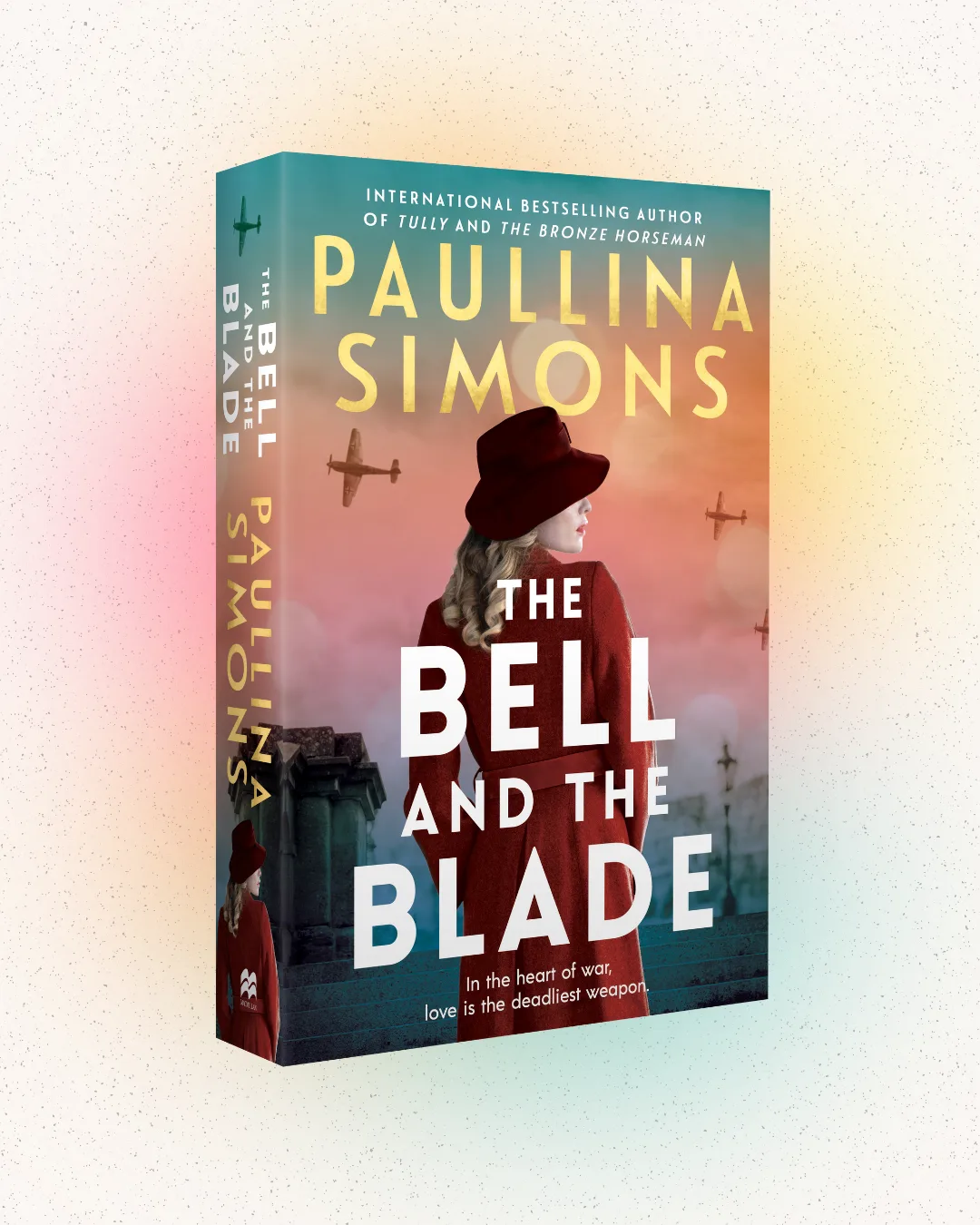
Paullina Simons, the internationally bestselling author of The Bronze Horseman trilogy, blends romance and history in her works, and her latest novel, The Bell and the Blade, continues that tradition.
Set in 1944, the story follows a group of Allied soldiers and brave female freedom fighters in occupied Belgium. Tasked with a dangerous mission, they must navigate impossible choices, where survival and loyalty are constantly tested. Amid the tension and danger of war, these unlikely allies confront impossible choices and showcase the resilience of the human spirit and the power of love in the darkest of times.
Read on for this exclusive extract from Paullina Simons’s The Bell and the Blade, now available from PanMacmillan Australia.
Chapter 1: La Berceau
IT WAS A NIGHT to forget—or perhaps it was a night to remember.
Charlie gripped the wheel as she drove into Antwerp, heading toward the old docks, her forged papers lying on the seat beside her. She didn’t even know who she was hiding from today.
She had become an expert at subtraction. Strip the colour. Muffle the light. Remove the name. She reduced herself to mass and motion—steady, silent—a tensile body of a woman who never stopped moving. Her cap was pulled low, her short hair tucked, her coat loose enough to disguise shape and shift. Her pale lips faded into shadow. Her deep brown eyes were lit with watchful fire. But she always felt a fraction misaligned, like a body conducting no heat, or a particle in hiding.
Seamen spilled from the smoke-choked taverns, the clatter of boots and bottles echoing off wet stone. Past the yellowing lights along the harbor, the Scheldt River lay black as oil, slapping the hulls of a thousand ships tethered till morning. It was early June but raining like it was late December. Drunken tempers flaring, men breaking into laughter, falling, calling for their commander. Someone shouted “Rendez-vous! Surrender!”
The rain slicked everything but didn’t cool the fever. Sailors stumbled against one another, singing, sobbing. One of them grabbed a German Polizei by the lapels and shook him. The gendarme shoved him off and kicked him down the cobblestones, almost good-naturedly. Get out of here, you drunken hoot, the shiny German boot seemed to say.
Charlie drove her father’s flower truck carefully, threading through the clamour, avoiding the roar of wild men who had nowhere to be, as if tomorrow didn’t matter.
Or as if tomorrow were all that mattered.
It wasn’t normal, this cacophony in the night.


But on Jordaensstraat, by the castle ruins on the edge of the Old City, it was quiet as always. Here, the docks were smaller, older, mostly deserted. The quay was crumbling, and there were no cranes to help with heavy loads. Everything had to be done by hand.
She parked in her usual spot behind an abandoned warehouse by the river. La Berceau was the smallest and oldest of her father’s trucks, narrow in the frame and wheezy going uphill, but it had one thing none of the others had—a secret compartment underneath a false floor. That’s why she had named the truck the Cradle. She and her two brothers had installed it with a sliding panel and a hidden latch, using two planks and a prayer.
The wind and the misting rain carried the salty sea into her nose and throat and made her feel as if she were sick or weeping. But she was neither. She was fretful and impatient. Popping the clasp, she released the scrawny boy from the truck’s hold.
His name was Zeus.
It had taken her a long time to find him. She’d driven all the way down to Charleroi to retrieve him and his brother from a Carmelite hostel. But Zeus was alone. They didn’t speak of it. He just went with her. The child’s face was wide and his hair cropped and curly, the kind of hair someone who loved him might want to ruffle. When they first met, he said he wasn’t sure if she was a girl or a boy. When she said she was a girl, he puckered his mouth as if he didn’t believe her. A precocious child.
“What if they spot your truck here?” Zeus asked. “Won’t they get suspicious?”
“They don’t come back here on Friday nights. Don’t worry. We always do it like this.”
“Maybe you should park where other trucks are parked,” the boy said. “But then we’d have farther to walk to get to the ship. More chance of getting stopped by roving patrols.”
He began to ask another question, but Charlie stopped him. “You’re not my first boy, Zeus. And you won’t be my last. Trust me. This is the safest way. Now be quiet and come.”
“If we’re so safe, why do I have to be quiet?”
She observed him warily. Someone should’ve told her he’d be like this. A year ago she’d picked the lock on a back door to the warehouse, installed her own, and tonight they entered the vast space easily. They
walked to the front, which faced the quay where the old Portuguese ship, the Serra Nova, bobbed in the glimmering water.
“Should we open the window?” the boy asked. “So we can climb out quick when the time comes?”
“No, Zeus. I told you—the patrol shines lights in these windows as they walk past. If a window is open, they’ll see.”
Charlie could tell the boy wanted to take her hand. She wanted to pat him, tell him not to worry, that everything would be okay. But how okay had everything turned out so far? She didn’t want to lie. She said nothing.
“When do they come?” “I told you, at ten.” “I’m ten.”
“I can’t believe you’re ten already, Zeus.” “What time is it now?”
“Fifteen more minutes.” She took a breath. “I don’t like waiting either,” she admitted. What an understatement. “It won’t be long.”
Charlie knew the captain, Andres Ferrer. They’d been conducting business for two years. Ferrer brought Portuguese olives and cork into Belgium and exported Belgian textiles and beer to Lisbon. Textiles, beer—and small Jewish children. For this, Ferrer got paid, and Charlie got paid. The money funded her resistance work and left her beholden to no one—exactly how Charlie wanted it. To be beholden to no one.
It all flowed easy as olive oil. It was a well-practiced silent pantomime. She had explained it to Zeus, but he was an exceptionally questioning child. She had to tell him over and over. This was why Charlie preferred to transport the children in pairs. You were never as afraid when you had someone with you. “It’ll be fine, Zeus,” she said. “But be quiet.”
“Why do I have to be quiet if it will be fine?”
“Because I need to focus, and I can’t when you’re asking me a million questions. If I miss the signal, it will not all be fine.”
The boy stopped talking, and the two of them stared through the dirty glass. The boy wiped the dust off with his little hand to see the ship better. She waited for the German sentries to make their hourly patrol down Glaskaai. They marched to the walls of Het Steen Castle, then turned around and slowly walked back. As soon as they were out of sight, Ferrer would flash a light—three short, one long—giving her the all-clear. Charlie and her charges would open the window, climb out, and run to the stern of the ship, where a side cargo door would open. They would rumble up the gangplank and disappear inside.
She would say hello to Andres, and settle the child deep in the lower hold, past the barricade of crates and pallets. She’d give him some food, water, a book, a flashlight, go over the passwords, then lock him inside. She’d pay Ferrer, and before she left, they would have a convivial smoke together—another mission successfully completed.
Charlie thought if their time together had been lengthened and the war shortened, Andres might have expressed another, more romantic, interest in her. But who had time for romance these days?
Friday night was a good time for this exchange, because the rest of Ferrer’s crew was off at the pub getting plastered. From the flashing signal to the cigarette took seven minutes.
But that wasn’t what happened this Friday night.
Because on this Friday night, the men were reckless on the stones and nothing was ordinary and nothing took seven minutes.
Charlie felt the first alarm when ten o’clock came and went, and there was no patrol. She wiped the face of her watch, just in case she’d misread the time, then pried open the window.
“I thought you said not to open the window?” Zeus said. “Shh, I need to listen.”
The German guards were punctual like pistons. Charlie knew them by form and shape, knew their weapons, their purposeful gait, the smell of their cigarettes, the cadence of their chatter. But tonight they were absent, and the strong wind brought not a whiff of the tobacco smoke that signalled their arrival.
She and the boy continued to wait, but her hands started to shake. Something was wrong. She’d been right to note the drunken cacophony when she first drove in. She should leave, run, take the child to a safehouse, and try again another day. But Zeus needed to get on that ship. This wasn’t for her. It was for him.
From the distant alleys, where the city was still alive, an accordion wheezed a half-forgotten tune, swallowed by night and wind. This part of Antwerp was nothing more than a still painting: the black silhouettes of ships against the maw of the sea, the crumbling stone castle looming over the shoreline, a waxing crescent moon hidden behind silver-black clouds.
The boy whispered, “What is that song?”
She couldn’t remember, though she’d been humming it under her breath for minutes.
Finally, it came to her. “Parlez-moi d’amour.” Talk to me about love. Tell me beautiful things again in my heart I’m never tired of hearing it. I love you, but deep down, I don’t believe you. Yet I still want you, need you, wish for you to tell me the words of love that I love.
Briefly closing her eyes, Charlie gave a pained sigh and checked her watch.
It was 11:30. No! That couldn’t be right! And still no patrol in sight.
Maybe the Germans had sampled a little homemade beer and confused the hour? Had Andres gone out for a nightcap—or five—and forgotten to return? Charlie might not have thought much of it had the Germans not been patrolling the outer Scheldt docks with the exacting precision of priests ringing the bells of Saint Waltrude, every hour on the hour from dawn to midnight. Other alarming things were happening, which, combined with the lack of Nazis, added to her panic. Andres Ferrer was missing too. Why had he not flashed the sign at the appointed hour? Could two unlikely absences occur simultaneously for unrelated reasons? That strained credulity.
Something must’ve happened. Things were happening everywhere.
There was chaos in the square.
“Do I go now?” Zeus whispered.
“Go where? No, Zeus.” Could she have missed the sign? She did close her eyes for a moment when she allowed a breath of nearly forgotten heartbreak to flow into her chest. But Ferrer would’ve flashed again. He knew to signal three times more. It had been over ninety minutes.
Intently, Charlie watched the darkened Serra Nova.
In the stillness, fear was born. Serra Nova was moored in its usual spot on Glaskaai. Normally, the berths next to it were vacant, but tonight, another merchant ship bobbed to its left, heaving against the pilings. It was longer than the Serra Nova, slightly wider, though just as dark, just as locked up, just as abandoned. Squinting, she tried to make out the name in faded white across the prow. La Fortuna. Reading that name, something heavy and foreboding tolled inside Charlie’s chest. She almost trembled.
There was a Belgian flag on her mast, a Portuguese trading flag below it, and below that, a swaying white flag painted over with a narcissus—a daffodil. A bespoke flag of a painted yellow flower seemed odd for a merchant ship, too personal. Almost as if it weren’t a flag, but a sign . . .
“Charlie!” Zeus pointed. In the dark, broken only by a flickering gas lamp, a group of black-clad men appeared out of the shadows. She emitted an audible gasp. Quickly they crossed the quay and hurried down the narrow wooden wharf at the broadside of La Fortuna.
The interlopers fanned out along the ship’s flank, grabbed onto the mooring ropes and expertly wound their way up the rough knotted twine. They looked chillingly professional. On the freeboard of the ship above the waterline, they found ladders and grappling hooks and climbed up the hull like spiders, to the top of the deck, noiselessly vaulting over the railing—Olympic athletes all. The ship’s mass groaned against the pilings, but otherwise there was no sound except for the distant whine of the gut-wrenched accordion.
“Charlie,” Zeus whispered, “are they coming for me?”
Oh my God. She put her arm around him. “No, dear boy,” she whispered back. “That’s not our ship.”
His body was stiff with tension. “Are they Nazis?”
“I don’t know—please be quiet.” Perhaps they were looking for another Zeus—or many Zeuses? It made no sense. Why would they need to climb in stealth? The Nazis carried out inspections anywhere, anytime, the louder the better.
Charlie heard the intruders trying to pry open the ship’s cargo doors. It was so quiet, she could hear their breathing, their muttering in German. Zum Teufel! Verdammt! Finally one of the hatches must have sprung open. But there was no relief, only surprise all around: from the men who came uninvited, and from the men below deck who greeted them. She heard one hiss in German, “Wer sind Sie?”—Who are you?—followed by a loud response in French, “Qui diable êtes-vous?” Who the fuck are you?
The voices carried back and forth in the night air: intense, combative.
Interrogative in German. Declarative in French.
Abruptly, the conversation ended. Muffled voices shouted commands, louder voices responded in protest. She heard rushing footsteps, saw shadows of men lunging at each other. Charlie clasped a hand over Zeus’s open mouth, but who was going to clasp a hand over her own?
There was whooshing, grunting, the whistling of metal. She heard gasping, and stifled cries, heard the sucking sounds of lethal conflict, of men ordered to make no noise under mortal duress and making noise anyway. The bodies of men fell on the deck. A metal object rolled; there was a stampede to recover it. Blades caught the crescent moon, dull flashes of silver rose—and plunged down. Agony of metal piercing human flesh. Groans that could not be silenced.
Something dark and heavy leapt into the river off the side of the ship. Another thick jump, then a battle in deep water—a breathless, violent, watery commotion.
In the dull cloudy shimmer, there were fewer and fewer shapes of men standing, fighting. Fewer and fewer silver flashes in the moonlit darkness. “Don’t make a sound, Zeus,” she whispered. “Don’t even breathe.” She wanted to close the window but knew she couldn’t. The window creaked, and she didn’t know who else might be nearby. From her low vantage point, she caught the last slivers of men’s raised arms, silent blades, the gasping, gasping getting fainter . . .
Charlie gasped herself. And then all was silent.
The somber bells of the Cathedral of Our Lady began to toll midnight, echoing across the stones and the water.
Zeus’s eyes were like moons themselves.
She jumped to her feet. “We need to leave, Zeus.”
“What about my passage?” He rose a lot slower than she.
“Zeus, what passage! No captain, no crew, no signal, no safety! And any second this place will be overrun with Nazis.”
“Weren’t those Nazis?”
“I don’t know what that was,” she said. “We need to go. Before they close all the checkpoints. Hurry.” Charlie couldn’t hide the fear on her face. She couldn’t even pretend for a ten-year-old! She felt shame, but no bravery.
She was about to slam the window shut when Zeus yanked on her sleeve. “Listen!”
Charlie was done listening. “Do you hear it?”
“No, and I don’t want to. Let’s go.” “Listen!”
“No!”
Across the cobbled quay, a man’s voice was calling softly for help. Charlie saw a shadowy hand reach up from the black water to grab the coping.
“It’s a Nazi, Zeus! We must run!” “Not a Nazi! Listen.”
The man was pleading in French. “Au secours! Au secours!” A desperate, intimate cry for mercy.
“Zeus, we can’t . . .”
But the boy was already climbing out. Well, why not? He didn’t have anyone but himself to worry about. Charlie had to worry about him, her father, her mother, her brother, Louise, her entire resistance cell, and dozens, maybe hundreds of people whose lives would be at risk if she and the boy were arrested at this part of the docks they weren’t supposed to be near, having witnessed a slaughter they definitely weren’t supposed to see. That the boy would be shot was self-evident. But she would be tortured first. What did Zeus care for any of that? The boy was leaping out of windows! Charlie had no choice but to climb out and run after him to the waterline. There, a bloodied hand grasped one of the steel bollards. A panting black man hung on, weakly mouthing, help me.
Oh my God, mouthed a stunned Charlie. “Told you—not a Nazi,” said Zeus.
Her first impulse was to bolt.
Also, her second impulse. And third.
“We are in terrible danger,” the man gurgled.
No kidding, she wanted to say, speechless and motionless. “I beg you, help me . . .”
“Charlie!” said Zeus, pulling on the man’s arm in a futile attempt to drag him out of the water. The boy was pitched so far forward, he was about to tip over and topple in. Instinctively, she grabbed the back of Zeus’s jacket.
She was so afraid to be out in the open like this. Afraid, and unarmed. She’d left her Browning hidden deep in the truck in case she was stopped and searched on the docks. It was verboten for Belgian civilians to carry weapons in their own country. Instant execution if you were caught with a weapon. She felt danger all around her, a numbing terror.
Without her help, this gravely wounded man would fall backward, bleed out and drown, and then she, Charlotte Fontaine, could walk away, run away, and maybe even try again with Zeus another day, though in her heart of hearts, Charlie suspected that the human salvage business might be done with for good this time.
“I can’t,” she whispered, tugging on Zeus. “I’m really sorry, but I can’t.
Let’s go, Zeus.”
“Please!” said the man. “Please!” said Zeus.
What could she do? With hostile reluctance, with tremendous aversion to conflict—which perhaps was ironic, given the daily business of her life the last two years—Charlie crouched and, taking a shallow, miserable breath, grabbed the man’s waterlogged sleeve.
“Robert Capelle,” he croaked. “Find him in Jette ” His throat stopped forming words. Blood bubbled out instead.
“Who is Robert Capelle?” Charlie cried. “And tell him what?”
“La jonquille est morte,” the black man gasped, and lost consciousness.
The narcissus is dead.
The Bell and the Blade, by Paullina Simons, is available to purchase now, published by Pan Macmillan Australia.

