





Content Warning: This article discusses topics which may be distressing to readers.
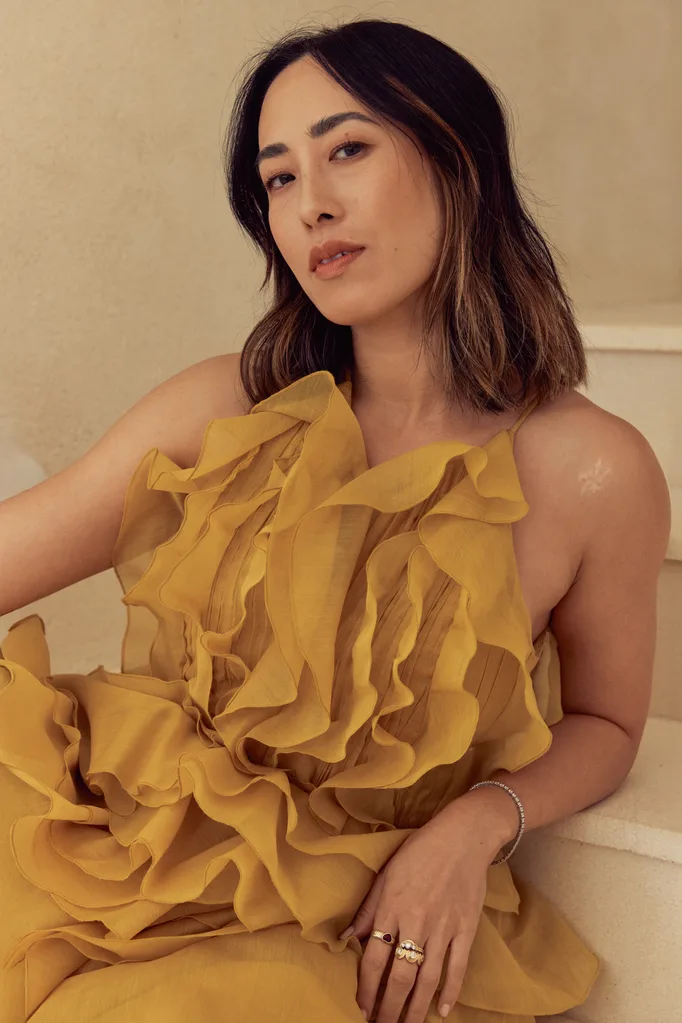
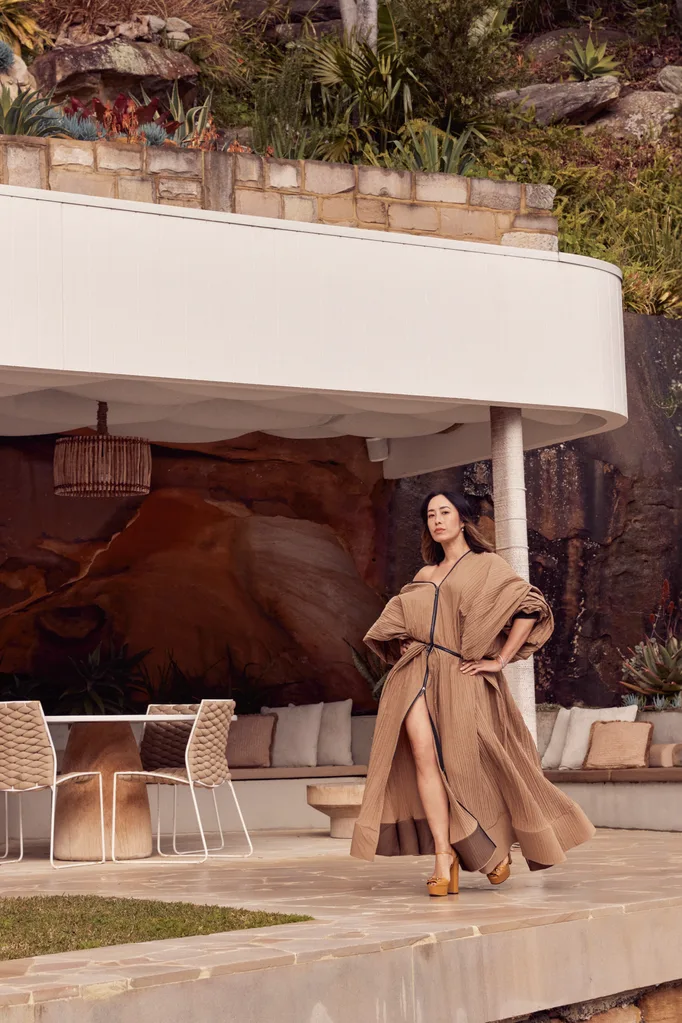
Once notoriously private, Melissa Leong is finally opening up about the traumatic events of her past, in the hope that sharing her stories can help others. We sat down with her to speak about her story of resilience which she shares in her powerful memoir, Guts.
Melissa Leong would like to go to Iceland. It’s an off-hand comment, made at the end of a long and tear-streaked conversation about her memoir, Guts, in answer to a question about the future. Does she have some concrete goals, or will she go where the wind takes her? Melissa says it will be a little of column A and a little of column B.
“I think you should always leave space for life to happen and for unique offers to come your way,” she says. “Send me to the farthest places that I can imagine and have me do the most unlikely of things and you will probably find that I will say yes.”
She singles out Iceland. So we are putting that desire in print and out into the world, because not only would Melissa bring her characteristic rigour and curiosity to an Icelandic food project, but when you get to the end of her courageous and revealing memoir you feel compelled to lead by her example and spread generosity.

Over 320-odd pages, written in a six-week blaze of creative fury, the food writer best known for her four-season stint on MasterChef Australia has cracked open her rib cage and shown us her heart. Melissa forged into the project with the same fearlessness with which she learnt to skin a rabbit in Tasmania. And she gives an unflinching account of her unconventional path.
Alongside her squelchy, slurpy odyssey of a life lived through oozing, buttery, pungent, unifying, restorative food, she traces her childhood in a strict household where her father ruled by corporeal punishment and she grappled with schoolyard racism. Later she faced mental and physical health hurdles as she gritted her teeth to rise through the ranks of the unforgiving hospitality industry. She endured betrayal, sexual assault, self-harm and a marriage so stifling it induced an eating disorder. Despite all this, she searches for and celebrates optimism. She carefully chooses the things she shares and those she keeps to herself. She only reveals what she thinks will be helpful to others.
“Wherever I share something that’s quite difficult, I’m doing that because I know that, if I’ve gone through it, then a lot of other people have gone through it as well,” she says. “I share these things because I have the hope that it might make one person feel less alone in their own experiences.
“I think we all feel pressured to have this idea of a perfect family set-up and no family is perfect because humans aren’t perfect. So, feeling bad about a life you never had is something I think we need to let go of.”
Melissa’s upbringing was marred by beatings. “A large part of the childhood my little brother and I had was spent living in fear of being beaten for the tiniest infraction,” Melissa writes.
“My father still won’t apologise for all the damage he inflicted, insisting that it was how he was raised and that it was done for my own good.” It’s an experience she knows is common among Gen Xers and Millennials raised in migrant households.


“It’s not an easy subject matter,” Melissa says. “My dad is still alive so having to – choosing to – write about this with my parents still alive was a difficult choice, but it’s an honest one. I don’t want people to assume I have a perfect life which is why I have a successful life. I want people to understand the context of the experiences I have had to become who I am, and it was very hard earned.”
The book also honours an upbringing of rich culinary experiences, and the expression of love through nourishment and the labour of food preparation. This extends to her mother’s willingness to acquiesce to requests for “normal” school lunches. She readily subbed out leftover Lo Mai Gai (sticky rice) for chicken in white bread rolls (with tarragon).
When asked what her death-row meal would be, Melissa answers without hesitation that it would be her mother’s Hainanese Chicken Rice.
“It’s such a special dish for me,” she says. “It’s one of the first dishes that I learned to perfect myself when I left home because I love it so much that I couldn’t bear the idea of not being able to have it when I wanted. Of course, there are wonderful restaurants that are purveyors of Hainanese chicken rice … but the reason I started learning to cook is I didn’t want to be beholden to other people to cook for me in my life.
“If I wanted to eat a particular thing, knowing how to make it yourself is really satisfying. I learnt how to cook that, and cook it and cook it and cook it, until I could do it with my eyes closed.”
This self-reliance and discipline, desire to strive and grit to follow through is a consistent thread of her story. Her mother kept her grounded as she found her path forward.
“My mum is someone I speak to almost every day, and she always has little nuggets of wisdom for me, but most of all she listens, and she just lets me talk,” Melissa says. “I’m very appreciative of her generosity on every level. She’s amazing.”
Born in Sydney to parents who immigrated from Singapore, Melissa spent her childhood “living between cultures” in Sydney’s southwest.
“We give up something to fit in and that’s unfair sometimes,” she says.
During her tenure on MasterChef, she wrote a column expressing her regret that, as a child, she’d hidden parts of herself. At the time, she wasn’t sure how much of her writing her mother read, if any. Melissa was sitting outside a physiotherapist’s office shortly after the column came out when her mother called. She’d read the column, and wanted to apologise. “I’m afraid I taught you how to do that,” she said.
Melissa’s mother recounted a story from her career as a nurse, where she had fastidiously communicated in “perfect Singaporean Catholic School-educated English”, as Melissa puts it. She had adopted this professional persona so completely that one day, when she was asked to urgently translate for a Cantonese-speaking emergency patient, she froze. “She had trained herself to fit in, and because she’d done such a good job at that, someone nearly died,” Melissa writes.
Melissa sat listening in her car and they cried together. It was a breakthrough moment.
“My mum is of that generation where you just push on with things,” Melissa says. “Learning to be vulnerable and have these hard conversations is new for her … I’m really glad we did that because it made us a lot closer and it also helped me understand the grief that we have for loss of culture that I know I share with a lot of people.
“My culture is very … you process things yourself. You keep your cards close to your chest and we don’t have those heart-to-heart moments. We express ourselves and our appreciation for each other through excellence, which is hilarious, and I joke about that a lot.”
From an early age Melissa exhibited a capacity for excellence and a disinclination for the conventional. She begged for piano lessons, and when they were granted, she showed real talent. Dreams of training at the Sydney Conservatorium of Music to become a concert pianist were foiled by crippling bouts of RSI. Something she still lives with on and off today.

The post-university years brought encounters with creative people but also moments of true desolation. Melissa is candid about her battles with depression and anxiety.
“I am very fortunate to have gone through therapy from my early twenties onwards,” she says. “Working through difficult themes in order to live a better life as we walk forward is something I’m very much a fan of.”
However, she learnt to listen to her gut when something isn’t right. She left a budding career in advertising to find her own path as a travel writer and PR maven. Then, she worked with Adriano Zumbo after the dessert chef’s bakery was mobbed after his first appearance on the hot new cooking show, MasterChef. She co-created a series of food events celebrating the brightest rising culinary stars, Taste of Young Sydney (TOYS), and won a Good Food Award for Innovation in 2011.
During these years of graft and joy, Melissa reached dazzling heights and colossal lows – she also survived a rape, which she writes of sparely – but she was constantly busy, moving too fast for even her own emotions to catch her.
After a decade of striving, hustling and juggling, Melissa took a food sabbatical in Tasmania, seizing opportunities to better appreciate where our meat comes from. That’s where she got the rabbit-skinning lessons. (In her pyjamas in the middle of the night, no less.) She did time on an abattoir killing floor. It was challenging and nourishing. Until she found herself howling in grief and covered in blood in a veterinary clinic in Hobart.
Her cherished French bulldog, Bunny, had been hit by a car on an isolated farm. Melissa had driven at blistering speed to get him to an emergency vet. When Bunny didn’t survive, it was like a finger being removed from a tiny hole in a dyke. A lifetime of grief came pouring out.

Reeling, Melissa sought professional help and forged further into her food education. “I learned how to hunt and fish and process my own meat and all of the difficult things,” she says.
“As lost as I was as a human, being there and diving into food in a very different way than I was used to gave me something to hold onto when I needed to continue to move forward. So, I’m very grateful for that. Whenever I’m lost, I look to food. Food always helps me get back on track again.”
The way Melissa talks about her work and education in food is so suffused with spice, sugar and salty soy, you expect her memoir’s pages to smell like salty pork crackling or a spongy, syrupy, zingy slice of lemon drizzle cake, which is Melissa’s death-row desert. “It’s probably one of my all-time favourite things. Light, zesty, citrusy, but full of sunshine as well.”
This makes it all the more poignant and tragic when her relationship with food becomes strained, even toxic, during the difficult times in her life.
Melissa has kept the details of her marriage private but wants to share the broad experience in the hope of being a kindred voice for someone going through something similar.
Given her love of food, it’s not surprising she fell hard for a chef. After three months of dating, they were engaged, then eloped to California’s Joshua Tree to exchange vows. In an ice-blue vintage mini-dress, with starburst sparkles beaded around the collar and cuffs, Melissa said “I do”. The minimalist, rock-chic ceremony in the Mojave Desert was so picture perfect that the photos were published in Vogue.
The fairytale shattered almost immediately. Reflecting on the elopement, Melissa writes that it was logistically perfect. “Unless you’re running away to get married because you know you can’t stand in front of the people who know you best because you know they know this is all a huge mistake.”
She uprooted her Sydney life to fit into her new husband’s Melbourne routine. As the owner of a bar, that meant long work hours that often slid into post-shift drinks.
Melissa became what is known as a “hospitality widow”. She was often left alone in her husband’s shabby inner-city share house with flatmates who didn’t wholly accept her. She dealt with the loss of control by purging her food. She would throw up in the share-house bathroom, then scour the bathroom in a mania of penitence.
“It was a really bad time,” she says.
“My eating disorder manifested itself because I had no control in any other aspect of my life,” Melissa reflects. “I’d relinquished it. I found myself in a very difficult place where I no longer knew who I was. And, I no longer felt any sense of agency over my life. I had devoted my life to a situation that was ultimately always going to be futile.
“I think of food as a lifeline and a luxury, so a deprivation of food speaks volumes in terms of the way I saw myself and the fact that I didn’t think I deserved it. Eating disorders are about control … It’s just a deep, systemic sign of unhappiness and wouldn’t you know it, the second I signed those papers it never happened again,” she says, referring to her divorce.

“Beyond that, I’m not really comfortable talking about the nitty gritty of it because I feel that’s best left where it is,” she says of her marriage. “But the reason I share the story about the eating disorder is that our bodies tell us so much about what we need to know about ourselves.
“In not listening to my gut, I ended up in that place. And by addressing a very important issue in my life, I was able to find a way out of that time. I think a lot of people, especially as women, we find ourselves in positions in life where we live to serve others and we forget to take care of ourselves.”
It taught her to look after herself before trying to look after others. “I’m of no use to anybody if I’m not whole.”



It was MasterChef that ultimately gave Melissa the confidence and financial means to walk away. That and the love and support of close friends. “We’re nothing without community,” she says, and her girlfriends who were there to listen when things got “complex or ugly” are a vital part of her story. As for MasterChef, while she doesn’t want to be defined by her time at the helm of the TV-ratings juggernaut, she’s grateful for it. After emancipating herself from her marriage, she rebuilt her relationship with food.
“Slow cooking food is always a good one for me. When you are not in a hurry to cook, it gives time to reflect.” Also, “delicious carbohydratey things. Carbs never hurt anyone. We need to stop demonising carbs, so eat them please.”
Despite the difficult terrain Melissa traverses, Guts is ultimately full of hope and encouragement. She is a big fan of therapy, taking care of yourself, and being open about universal experiences. Amid the broader, overarching message of her memoir are smaller gems of wisdom she has picked up along the way. Things she wishes someone had told her when she felt lost or alone, like “stand up for what you want” and “keep your heart and mind open. Love your friends. Take the trip. Eat the chicken feet. Follow your gut, and free the carbs!”
She doesn’t write about the hard times to garner sympathy, but to provide context. “I think that’s the most valuable thing we can do as human beings,” she says. “That’swhat vulnerability is, sharing our darker, more complex parts, because that’s what humanity is. We all have these elements in ourselves. If we can connect to other people that way, I think that’s an important part of the exchange of being on this planet. Otherwise, what is the point?”
“There are these themes that we all share in life,” she says. “I think if I can explain how I stepped through something and that might help somebody, that’s not a bad thing.”
This article originally appeared in the November 2025 issue of The Australian Women’s Weekly. Subscribe so you never miss an issue.
Guts by Melissa Leong is out now through Murdoch Books. If you or someone you know needs help, contact Lifeline on 13 11 14 or 1800 RESPECT on 1800 737 732 .