





By the time we hit our forties, most of us are starting to feel the creeping signs of a body that’s held children, carried the mental load, juggled work and caregiving, and weathered decades of stress – all of which take their toll on your midsection.
Your core strength really does matter more than ever in midlife and it’s often the missing link behind stubborn back pain, balance changes, pelvic floor issues and even fatigue.
According to emerging research, women begin to naturally lose muscle mass from around age 35 – a decline that accelerates through perimenopause due to falling oestrogen levels, which play a key role in maintaining muscle and connective tissue strength.
Bodylove Pilates founder Ali Handley, who has worked with hundreds of women through pregnancy, postpartum and perimenopause, says the deep core becomes particularly vulnerable as we age, especially if we never truly recovered strength after having children.
“The deep core is the system that goes through the greatest amount of change during pregnancy, birth and postpartum,” Ali explains. “Your superficial abdominals stretch, your deep abdominals separate, your pelvic floor undergoes huge trauma and then many women move on without fully reconnecting to that system.”
That lack of reconnection she says, creeps into midlife and can trigger a cascade of issues: pain, poor posture, a weak pelvic floor, and feeling off-balance or unstable.
Why midlife makes core strength weaker
Years of sitting, slouching, stress and busy routines don’t help. “Gravity’s been working on you for 40-plus years,” Ali says. “If the pelvic floor – the foundation of the core – isn’t strong and connected, that instability travels up the chain. Your ribs flare, your neck muscles tighten to take over, and suddenly you’re dealing with migraines, jaw tension or a stiff upper back.”
These compensations are incredibly common. Studies estimate up to half of all women over 50 experience pelvic floor dysfunction, and back pain is one of the most reported health complaints for Australian women in midlife.
This is why many women notice their posture changing – a little more rounding through the shoulders, a little more tightness in the neck. “We’re already spending our lives hunched over laptops and phones,” Ali says. “Overworking the superficial abs with endless crunches just pulls you further forward.”
What your core actually is
Your core isn’t a single muscle so much as a system. Think of it as a deep, supportive cylinder made up of the transversus abdominis (your built-in corset), the pelvic floor, diaphragm and tiny stabilising muscles of the spine, working in concert with the outer layers – the obliques and abs. Together, they steady the spine and pelvis, support the trunk and create a strong, stable base from which the limbs can move.
“When the deep core engages correctly, you lengthen, compress and support your spine,” Ali says. “You’re taller, more connected, and everything moves from a place of stability.”
That stability is what helps reduce back pain, support pelvic floor function and improve balance – three big concerns for women in midlife.
How Pilates can help
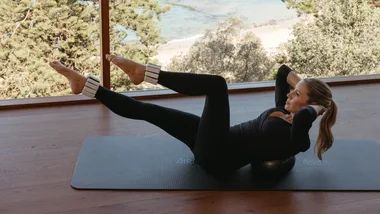
Unlike traditional ab workouts that focus on flexion (think sit-ups), Pilates builds strength from the inside out.
“The deep core muscles are thinking muscles,” Ali says. “You can activate them just by breathing and bringing awareness to the area, even without moving. It requires a mind–body connection.”
Pilates also encourages slow, controlled movements rather than powering through repetitions. “Slow is better,” she emphasises. “It gives the body time to recruit muscles that haven’t been turned on for a while.”
For women returning to exercise or feeling intimidated by gym environments, Pilates also provides a low-impact, form-focused option that can be adapted to any level. Research backs this up: a 2022 clinical trial found that Pilates significantly improved balance, core strength and functional mobility in women over 45 after just eight weeks.
Signs your core isn’t functioning well
Beyond the obvious one of lower back pain, a weak pelvic floor, migraines or jaw tension, feeling unstable or wobbly, overactive quads or glutes and poor posture or slouching can all be clues your deep core muscles aren’t working like they should.
The good news? Small daily habits that make a big difference. You don’t need an hour a day to strengthen your core, but you could try:
Breathing properly. Practice slow, diaphragmatic breathing, allowing the ribcage to expand rather than lifting the chest. The diaphragm is a key part of the deep core, and learning to breathe well can switch those muscles back on.
Exhaling on effort. Whether you’re lifting groceries, getting out of a chair or climbing stairs, gently exhaling helps engage the deep abdominals and supports the pelvic floor.
Strengthening from the inside out. Focus on low-load, controlled movements (such as Pilates-style exercises) that prioritise alignment and control over speed or intensity.
Being mindful of how you stand. Avoid ‘hanging’ into your hips or locking your knees. Think tall through the crown of the head, with the ribs stacked over the pelvis.
Supporting your pelvic floor during daily tasks. Lightly engage the pelvic floor before coughing, sneezing or lifting to protect and strengthen these muscles over time.
Prioritising recovery. Muscles rebuild during rest. Adequate sleep, gentle stretching and rest days matter just as much as exercise, particularly during perimenopause and menopause.
Addressing hormonal changes. Declining oestrogen can affect muscle tone and connective tissue. Tailoring exercise intensity and allowing more recovery can help reduce strain and injury.
Seeking expert guidance if needed. A women’s health physiotherapist can assess core and pelvic floor function and provide personalised advice. You usually don’t need a referral, but your GP should be able to point you in the right direction.

