




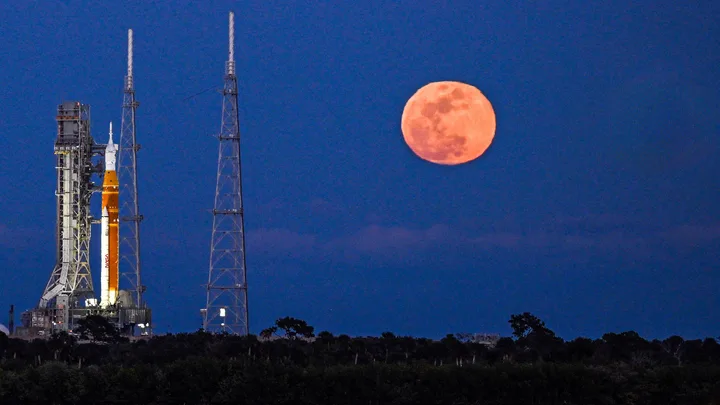
“It is so great to hear from Earth again,” said Christina Koch, mission specialist on board the Orion spacecraft, as the Artemis II mission crew returned from itheir 40-minute journey across the far side of the moon and regained communications with mission control. “To Asia, Africa and Oceania, we are looking back at you. We hear you can look up and see the moon right now. We see you, too.”
It has been an eventful and emotional day for the Artemis crew (commander Reid Wiseman, pilot Victor Glover, and mission specialists Christina Koch and Jeremy Hansen). Earlier, they reached their greatest distance from Earth – at 252,756 miles or 406771.352 kms – which is the furthest humans have ever travelled from our home planet.
There was a heartfelt moment on board when the crew proposed naming a bright spot they had identified on the moon after commander Reid Wiseman’s late wife Carroll, who had died while they were in training. “We lost a loved one,” said Jeremy Hansen and all four astronauts wiped away tears and embraced. The crater exists on the border between the dark and light sides of the moon and is sometimes visible from earth.
The astronauts, who had been observing the dark side of the moon on their flyby were then gifted another rare opportunity, witnessing a solar eclipse from space. The moon passed between the spacecraft and the sun, blocking the sun’s light and allowing the astronauts to put on “eclipse glasses” and observe the sun’s corona, or outer atmosphere.
What is the Artemis II mission?
The Artemis II mission blasted off on Wednesday (United States time) from Cape Canaveral in Florida, sending its four astronauts into space and on a flyby of the moon. It is an historic mission: the first time people have ventured to the moon in more than 50 years, and the first step in NASA’s plan to return astronatuts to the lunar surface, and eventually to Mars.
“Great view. We have got a great Moonrise,” said commander Reid Wiseman, as the spacecraft entered earth’s orbit, where it will remain for 24 hours before carrying on into space.
The Artemis II’s crew members are commander Reid Wiseman, pilot Victor Glover, and mission specialists Christina Koch and Jeremy Hansen.
What’s next after Artemis II?
The Artemis III mission, which aims to land the first American astronauts on the lunar surface since 1972, is scheduled to lift off by 2028. However, there are practical and financial obstacles to be surmounted before that happens, and information leaking from NASA suggests the entire Artemis enterprise may be running behind schedule.
“Artemis is ambitious, but also precarious,” says Jessie Osborne from the research organisation RAND Europe. “For now, funding is secured through the 2025 One Big Beautiful Bill Act, but the political consensus may not last. And international competition adds urgency to the financial considerations.”
The race to the moon?
NASA is not the only space agency shooting for the moon.
In October last year, a spokesperson for China’s space program said the country was on track to launch its own crewed mission by 2030. China has developed Long March rockets, a high-tech ‘Mengzhou’ spacecraft and a lunar lander.
With all this, says Jessie Osborne, “the Artemis II mission is not just another spaceflight … It is the test of whether the US can sustain its most ambitious exploration program since Apollo. It is also the foundation for future voyages to Mars. Success will reaffirm American leadership in space. Failure could cede it to others … The implications of lunar leadership extend beyond national prestige. They include access to lunar resources.”

Mining the moon
These new lunar missions could pave the way for mining operations on the moon, into which private investors are already sinking fortunes. The moon’s mineral riches are thought to include deposits of uranium, potassium, phosphorus, platinum-group metals and helium-3 (an isotope that could potentially power fusion energy).
Half a dozen American corporations are developing technology that could be ready to roll out as early as next year, and NASA’s Polar Resources Ice Mining Experiment 1 (Prime-1) is already there – recently delivered to the moon by an Intuitive Machines lander.
China and Russia are, meanwhile, planning the robotic construction of lunar bases, and an international lunar research station, to be operational by 2035.
On a smaller scale, a Japanese company is developing a mini rover to explore lunar resources, and the European Space Agency’s Argonaut program is developing its first lunar lander with the involvement and support of private investors.
And Australia is also involved in this space race. While the world watches Artemis II soar towards the moon, our Australian Space Agency is preparing for its long-term role in NASA’s Artemis Mission. The best known of Australia’s tasks is the development (in partnership with NASA and the Australian space industry) of a moon rover, christened the ‘roo-ver’ after the iconic Aussie marsupial. It is scheduled to lift off before the end of the decade to collect minerals and data from the surface of the moon.
Save the moon
Some are asking where this sudden race to exploit the finite resources of our only natural satellite could lead. Particularly given there is no effective treaty governing human activity.
The 1967 Outer Space Treaty established that space was not open for “national appropriation”, but questions remain about whether this rule encompasses private interests.
“The treaty’s Article I declares exploration shall benefit ‘all mankind’,” says RAND Europe’s Adam Urwick in an essay in The Conversation. But there is no mandatory mechanism for sharing those benefits, leaving it entirely up to the nations involved “to decide how, or whether, to share benefits at all”.
Again, the 1979 Moon Agreement designated lunar resources as the “common heritage of mankind” and tried to establish international guidelines, but it was only ratified by 15 nations, none of which have ever been to space.
In the years that followed, national legislation in the US, Japan, Luxembourg and the UAE have granted citizens rights to exploit “space resources”. And the Artemis Accords of 2020 set out some voluntary principles around lunar activity for the US and “like-minded” nations.
“The pursuit of profit raises paramount scientific and environmental concerns,” says Adam Urwick. “Astronomers caution that large-scale mining activities could disrupt ongoing research and preservation of the lunar environment … The technology enabling lunar resource extraction is arriving faster than most anticipated.”
Basically, we need to implement protections that “keep pace with innovation and growing appetites for lunar resources”.

Do we need a lunar treaty?
There have been calls for a lunar equivalent to the Antarctic Treaty, which created a zone of international cooperation and scientific enquiry, free from commercial resource extraction, militarisation and national ownership.
Adam suggests it needn’t go that far. “Binding international agreements which emphasise principles of stewardship, clarify access rights and support common benefits” would be a start.
As Grant Tremblay from the Smithsonian Astrophysical Observatory points out, managed carefully, the moon could provide unprecedented opportunities for international cooperation.
“Competition is real,” he says, “but so is cooperation at a scale that would have been hard to imagine a generation ago. International teams share data, expertise and the sheer wonder of discovery. The universe, after all, belongs to no one nation.”*

