





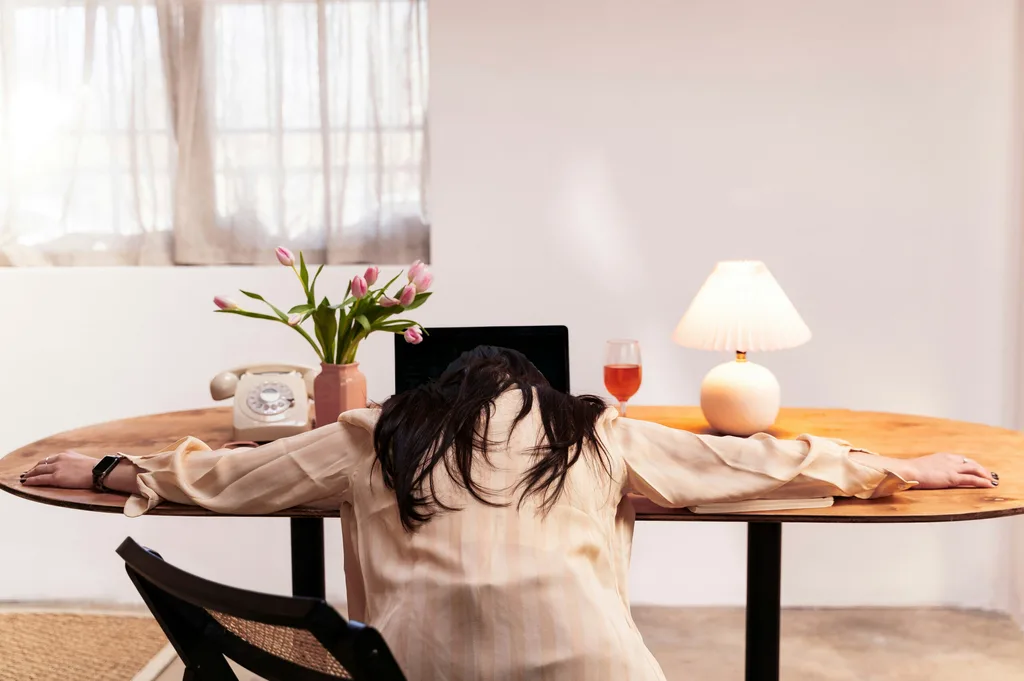
It began as an unremarkable workday. By lunchtime, I lay sprawled on the vintage office carpet, clutching my thigh. Biting my lips to swallow the almighty howl that was unfurling in my throat, I felt a rising sense of fear, confusion and indignity. How had it come to this? I had marched on with optimism! I had switched to flats and embraced a standing desk!
The persistent back pain had been oscillating somewhere between a distracting ache and a breath-stealing grip for months, but I never for a moment thought it could bring me down. A quick Google, most reassuringly, had confirmed 80 per cent of Australians suffer back pain at some point in their lives, and the majority get better with time, sensible movement and a positive mindset. I had given it all of that, but curled up in the foetal position trying to box breath through the fire ranging from buttock to knee, there was no denying that my Google-and-grit approach had fallen somewhat short.
I wasn’t alone. New research commissioned by Australian Chiropractors Association for Spinal Health Month found almost 87 per cent of Australian women experienced back pain in the past year. Of those, nearly half reported a moderate-to-extreme impact on their mental health, while almost half said cost-of-living pressures had stopped them seeking treatment. About 53 per cent had never sought a formal diagnosis.
Back pain was the fifth-most common presentation to Australian emergency departments in 2023-24 (155,000). I chose physio instead, but there was no avoiding an MRI. It revealed a common culprit: bulging discs in the lower back causing nerve compression (sciatica) and joint arthropathy.
“That’s a general diagnosis, and it’s best to start with conservative treatment to control the pain in the first three months as indiscriminate surgery can cause long-term problems,” says Michael Shacklock, musculoskeletal physiotherapist, researcher, educator and founder of Clinical Neurodynamics in South Australia. “Find a practitioner who wants to help you solve your problem by narrowing down from the general to the specific, who asks plenty of questions, listens carefully, follows clues, is hands-on and works out protective strategies that help you function.”



That proved somewhat challenging at first. A whirlwind month of dry needling, ultrasound, acupuncture, electrical stimulation and all manner of heavy-duty massage guns pummelling my butt and thigh kept the shrieking pain raging. Though every effort was well intentioned, I was blowing in the wind of conflicting expert opinion (stretch! Don’t stretch!) and the burden of new diagnoses rapidly piling on top of the nerve compression: Bursitis? Tendonitis? Perhaps segmental instability? Definitely abs and glutes that had gone on long service leave.

A sense of growing helplessness and burning shame at my atrophied buttocks kicked in. So did my social media feed, unrelentingly pressing me to buy a tens machine, supplements, exercise programs, mindfulness apps and sciatica pillows to dull the pain (none of them did). “We are all in an increasingly difficult situation because even some practitioners are getting information updates on social media,” says Michael. “If it’s too good to be true, it isn’t true.”
Two days before Christmas, I was urged to seek urgent medical attention for signs of paralysis – lower lumbar bulges (L4-L5 or L5-S1) can sometimes compress the cauda equina nerve that controls sensation and movement in the legs, bladder and bowel, prompting emergency decompression surgery to avoid function loss.
Is spinal decompression the solution?
Under the looming fear of being sliced like a Christmas ham, non-surgical decompression seemed the logical first step. On the costly end of the scale, there are fancy spinal decompression machines that will bend, rotate and stretch your spine, a computer adjusting the direction and angle of traction according to the targeted disc.
“From a technological point of view, disc decompression machines are a godsend,” says Dr Paul Lockart, chiropractor and founder of Kogarah Clinic. “The latest advancements allow us to decompress the compressed discs, get mobility back into the dysfunctional joints involved, and stretch the surrounding muscles all at the same time.”
I struck up a conversation in the waiting room with patients who had great success but there are also other accessible ways to decompress on the daily: hanging off monkey bars, dangling off a pool noodle in deep water, practising child’s pose, touching your toes, or even just squatting. Luck, as it were, also led me to discover an affordable decompression tool: the back block, a nifty invention by Sarah Key, author of the best-selling Back Sufferer’s Bible and physiotherapist of choice to generations of the English royal family. Her local reputation as a master of her practice preceded her – a tradesman friend (and then several of his mates) had faced spinal surgery and a permanent career change before a single treatment with Sarah (as well as crucial ongoing self-treatment at home) turned things around. Decades later, they were all still going strong and are wedded to her Back Block routine.



Sarah can be hard to catch in person as she flits between Sydney, regional NSW and running physio masterclasses in the UK (at the request of the King), but what transpired was quite extraordinary. ‘Reading’ my spine with her fingertips, she correctly identified every unhappy disc, whether mildly irritated or in the later stages of decline, an exact match of my imaging reports, which she hadn’t seen.
“Treating your hamstring is counterproductive,” she declared. “It’s wholly and solely a consequence of nerve irritation and would be like trying to catch a shadow. We have to really not threaten the spine but still go to the epicentre, where it is inflamed. The pain has got to be gently tapped on the shoulder.”
What causes back pain and sciatica?
Disc bulges are common and often painless, if they’re not squashing a nerve or chemically scalding it with fluid leaching from the disc.
“Discs are meant to bulge because they are shock absorbers,” says Sarah. Healthy discs have a high water content, allowing them to better absorb impact and hold the spinal segments together. “They are dependent on the suck and squirt engine of movement, sucking in and squeezing out the nutritious fluid around them like a sponge.”
Sitting for long periods is one way to accelerate fluid loss. Over time, a drop in disc height puts weight on the facet joints (bone-to-bone junctions). “When a disc is in its normal plumpness, the lumbar facet joint should only take around 16 per cent of the load through the segment. When you get disc thinning and bulging, that load can increase up to 70 per cent,” says Sarah. “When you load up facet joints, you can start irritating the nerve, causing leg pain. Nerves don’t like to be jostled around. The main thing is to ease the back out of that compression.”
Gentle hands-on treatment is an essential first step for all types of back pain. “When your back is unhappy, it goes into defence mode and switches on the muscles on either side of the spine,” says Sarah. “They are as thick as your forearm, and their compressive force is enormous and unrelenting. They’re like an overactive guard dog that barks at anything. You can’t stampede with treatment, it’s like yanking the dog’s chain.”

Her method is unconventional – the heel of her foot is her tool of choice to ‘unjam’ the spinal segments – but if even the Queen Mother was willing to embrace the irregular in exchange for the sweet thrill of pain relief, who am I to argue? I’m hardly a good candidate for relaxation, particularly stripped down to my bare essentials in company, but Sarah’s heel tinkering is quick and kind. For the first time in two months, the proverbial guard dogs are lying down for a rest.
What can you do about it?
In a nutshell, Sarah’s theory is that back pain goes through five stages: it starts as a stiff spinal segment (the most common cause of back pain), slowly dehydrating the buoyant ‘pillow’ of fluid between the discs, which, as they flatten, place weight on the facet joints. Over time, this can erode the cartilage covering the bone, causing arthritic change. From here, it can graduate to a sudden locked back, a ‘slipped’ disc and progressive instability.
“Take heart that most back problems are in the first 90 per cent stage one category and are quickly and easily reversed,” explains Sarah. I have dominoed into the later stages, but with several sessions of heel manipulation and some simple exercises at home, the agonising pain in my thigh recedes, and my back muscles begin to behave.
The whole process isn’t without setbacks, pain relief or patience (from me and everyone else in my life). While the reassuring words of a practitioner can be invaluable through the darker days of the acute stage, it also feels intensely empowering to know that I can do things to help myself, now and in the years to come. “Discs have a slow metabolic rate, so they both break down slowly and repair slowly,” says Sarah. “I find the function fault and can attend to the linkage problem, but back therapy is never an overnight thing, which is why you’re best off judiciously doing it yourself every day at home.”
My only regret is not seeking help sooner, shrugging off back pain as a symptom of the motherload. Keep calm and carry on has been the mantra for generations of women in my family, but this sobering chapter has reinforced the fine line between resilience and disregard. In mistaking the latter for spadefuls of grit, you might unwittingly unleash those barking guard dogs. And they can pin you to the ground in a split moment.
“All of us are walking around with spines riddled with stiff links,” says renowned Australian physiotherapist Sarah Key. “In some cases, particularly in the lower spine, which carries more weight, the link can become so stiff that it becomes painful. Those jammed spinal segments must be prised free through movement, both general and specific. I always say to patients, you mustn’t go rigid.”
How to sit properly
Don’t sit up straight! “If you’re sitting bolt upright, the back muscles are switched on all the time, and that’s a form of compression,” says Sarah Key. “What you need is support behind the lumbar spine.”
Sit close to your desk to prevent leaning forward towards the screen (an ergonomic chair won’t help if your back isn’t touching the support). “Your office chair should be angled down a few degrees at the front to prevent the whole spine slumping in a crumpled ‘C’ shape,” says Sarah.
Exercises for back pain
Sarah Key recommends these simple exercises every day:
- The Wiggly Wagglies: lie flat face down with a pillow under your tummy and gently twist your pelvis left to right to awaken the deep spinal muscles.
- Decompress: Use the Sarah Key Back Block (it comes with instructions) and place it under the sacrum (not on the spine). Drape passively over the block, hands above head, for up to 60 seconds.
- Knee rocking: Bring knees up to the chest and rock gently up and down. Sideways (dimple to dimple) is also relaxing.
- Spot relief: Soften a tight back muscle by lying on a small pair of socks or a squishy ball for gentle relief (trigger balls are often too hard)
Managing acute lower back pain
- Find an expert to identify the function fault: “Patients owe it to themselves to find someone that suits them,” says Dr Paul Lockart. “I recommend someone who can evaluate and treat both discs and facets. I would not recommend treating muscles alone.”
- Pain relief and heat packs help prevent tensing up. “This is important as pain begets pain,” says Sarah Key.
- Muscle pain can be relieved by stretching, but stretching can aggravate nerve pain.
- Rest can help initially, but keep as active as you can. “It’s the mobility of the joints of the vertebrae that enables the discs to draw in nutrient-rich blood to continually repair,” says Dr Lockart.
The article originally appeared in the June 2026 issue of The Australian Women’s Weekly. Subscribe so you never miss an issue.