




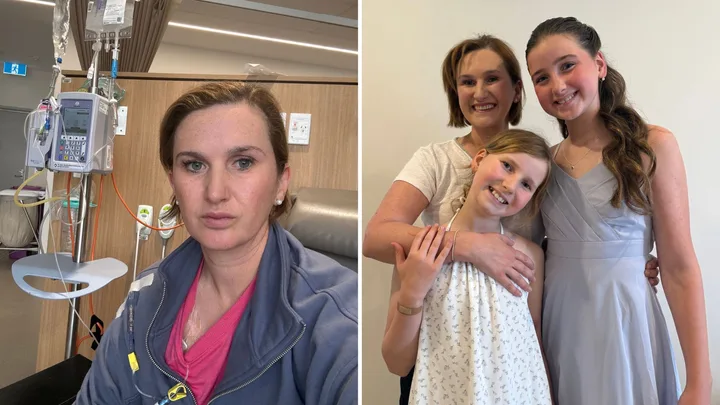
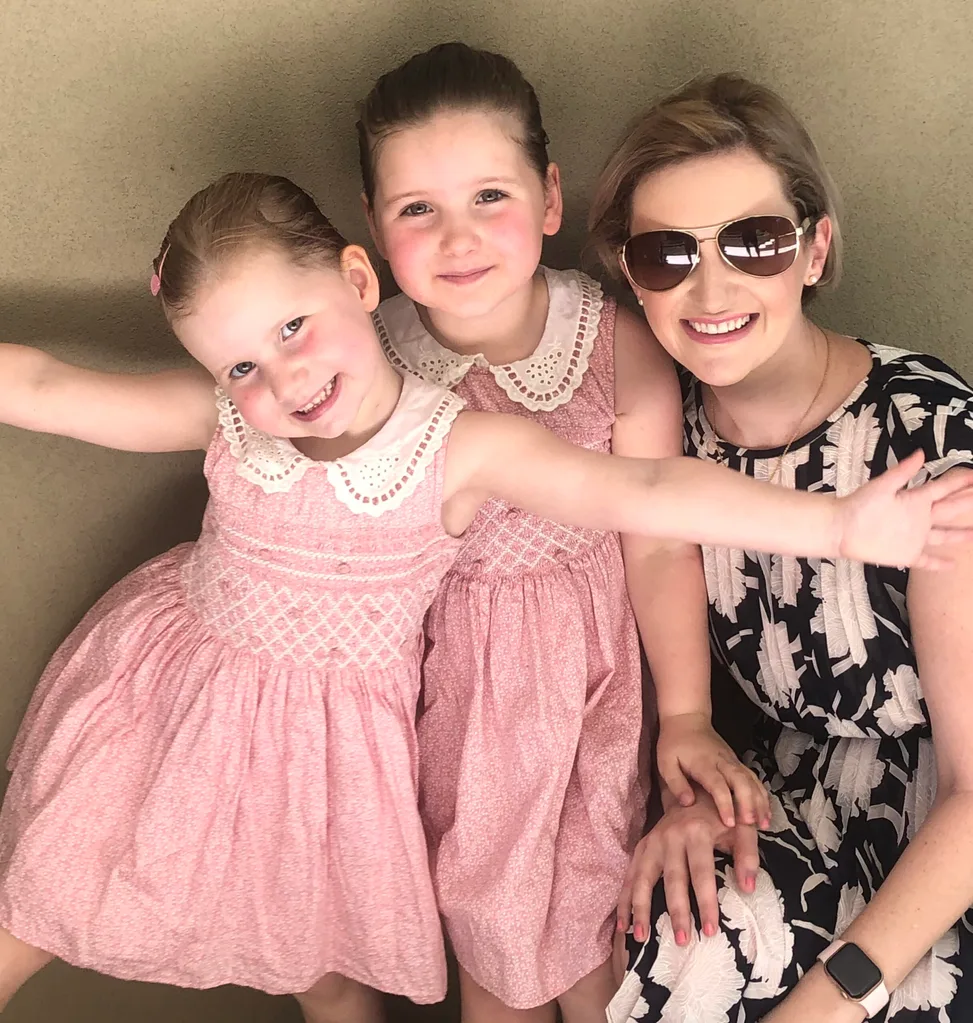
At 35, Gemma Farquhar had plenty of reasons to feel tired. She was working and raising two young girls, so feeling rundown wasn’t particularly unusual.
When her stomach started rumbling and she felt bloated, she brushed it aside. Maybe she had a gluten intolerance. Maybe she’d eaten something that didn’t agree with her.
But over the next four months, the symptoms became harder to ignore. Gemma developed “really bad abdominal cramping” and was occasionally vomiting too. She saw a number of doctors, who suggested gastro, a parasite or a reaction to food.
“I just knew something was wrong,” she tells The Weekly. “I just had to keep, keep on pushing and pushing and pushing.”
One night, the pain was unbearable. The next morning, her doctor sent her for a CT scan.
“Within an hour they called me and she said, ‘You’ve got colon cancer,’” Gemma recalls.
The scan showed a tumour was blocking her bowel. She needed emergency surgery.
“It’s like my whole world as I knew it turned upside down,” she says. “I just felt like I was gonna die.”
Why is bowel cancer rising in younger Australians?
Gemma was diagnosed with stage four bowel cancer. “I didn’t even consider it, didn’t cross my mind,” she says. “I thought it was an old man’s disease.”
Bowel cancer is Australia’s second-deadliest cancer, according to Bowel Cancer Australia. Although it is more common in older Australians, cases among younger people are rising. In 2024, under-50s accounted for around 13 per cent of bowel cancer diagnoses, up from 8 per cent in 2000. Rates among Australians in their 30s have tripled since 2000, and women account for roughly half of diagnoses among people under 50.
“Bowel cancer has long been thought of as a disease that mainly affects older people, which is why this shift is so concerning,” explains gastrointestinal oncologist Dr Julia Freckelton.
“We still don’t fully understand what is driving the increase, and that remains one of the biggest challenges for researchers,” she says. “The evidence points to a combination of factors, including diet, lifestyle, obesity, physical inactivity and changes in gut health, rather than a single cause.”



The symptoms that are easy to explain away
“One of the biggest challenges is that early symptoms of bowel cancer are general and easy to explain away, especially when you are young and not expecting something serious,” Dr Freckelton points out.
Persistent changes in bowel habits, abdominal pain, bloating, fatigue, unexplained weight loss and blood in the stool can all be mistaken for something else. Often, they’re put down to stress, diet, irritable bowel syndrome or haemorrhoids.
Australians aged 45 to 74 with no symptoms are eligible for a free bowel screening test every two years through the National Bowel Cancer Screening Program. If you’re under 45, speak to your doctor about your individual risk and screening options.
But if you have bleeding, unexplained weight loss or an ongoing change in bowel habits, don’t wait for a screening test – see your doctor.
“That is why it is so important to take new and ongoing symptoms seriously,” Dr Freckelton stresses.
‘I was told I had 12 months to live’
Gemma had surgery the next day to remove the tumour and 13 centimetres of her bowel. It was during the pandemic, and she spent nine days in hospital without seeing her children.
After her first round of chemotherapy, pain and vomiting sent her back to emergency. The cancer had spread to her ovary and Gemma was told she had 12 months to live.
“You do think you’re gonna miss all of these milestones for your kids and your family,” she says.
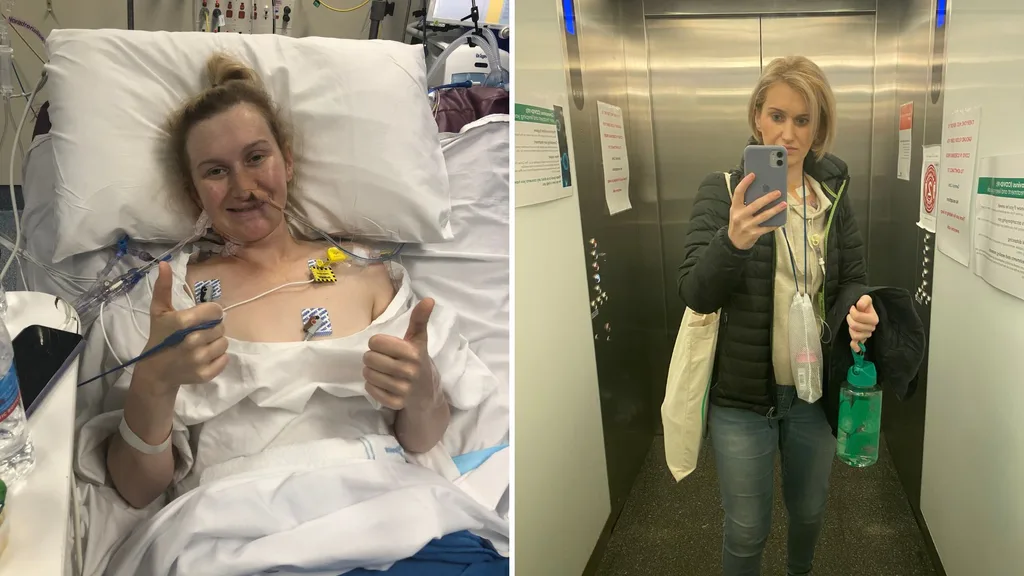
More chemotherapy and major surgery followed. When cancer was later found in her lungs, Gemma underwent further operations and radiation.
“You look in the mirror and you don’t recognise yourself as you knew it,” she remembers.
Six years on, Gemma is still receiving treatment. She takes four tablets a day and has a targeted-therapy infusion every fortnight. But she works full-time and lives a largely normal life.
“You would never know that I have cancer now,” she notes. “It’s almost like the invisible disease.”
Like many younger patients, Gemma has had to balance treatment with work and family.
“A more patient-centred approach means care that fits around a person’s life, not just their diagnosis,” Dr Freckelton says.
She is leading ORBIT, a national trial supported by GI Cancer Trials that aims to investigate the rise in early-onset gastrointestinal cancers and test more flexible, age-appropriate care for younger patients.
For Gemma, the fear hasn’t gone away. “Every three months I get a scan, and, you know, it all comes back, all the trauma, all the feelings.”
She has learnt to compartmentalise the uncertainty and pour her energy into exercise, work, holidays and time with her family.
“I’m always scared,” she admits. “But I do remain hopeful because I’ve got this far.”
‘If it doesn’t feel right, it’s probably not right’
Talking about bowel habits can feel embarrassing but Gemma would like us to get over that discomfort.
“When you have a baby, all you do is talk about poo,” Gemma points out. “Poo’s never gonna be pleasant. It’s never gonna be nice, right? But you can still talk about the ugly stuff.”
Her advice to women is simple: “If it doesn’t feel right, it’s probably not right.”

If those concerns are dismissed, Gemma advises women to keep asking questions. “If one doctor dismisses it, go to another and go to another, and that’s okay.”
Gemma’s children were four and six when she was diagnosed. Today, they are approaching 11 and 13, and she is here for the milestones she once feared she would never see.
“You don’t think you’re gonna be around, but you actually don’t know what the future holds,” she reflects. “I didn’t think I’d turn 40, and I turned 40. Now I’m nearly turning 42.”
She doesn’t take any moment for granted. “I cry at all, all the school things because I think I’m so lucky to be here,” Gemma says.
When her children ask why she’s crying, she tells them: “Because it’s a really special moment.”

