




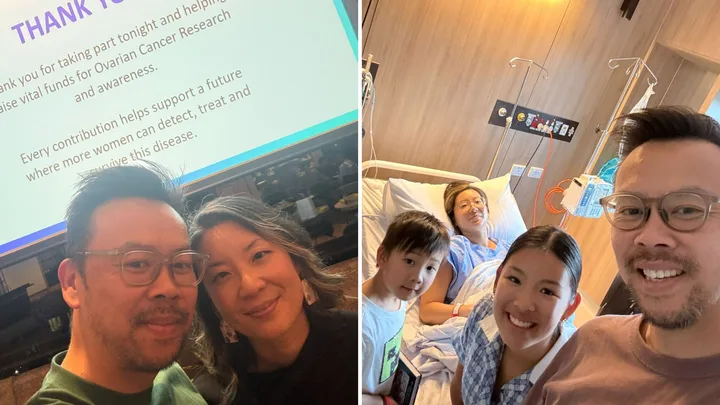
Candice Hung thought ovarian cancer was behind her.
She had been diagnosed at 37 and, after surgery, spent the next several years getting on with her life. Then, earlier this year, it came back.
Candice had gone in for what she thought was going to be a straightforward operation. But the planned keyhole surgery turned into a five-hour open procedure, and she woke to learn the cancer had returned.
“I was so groggy,” the now 46-year-old tells The Weekly. “I could just hear my husband saying, ‘It’s spread. It’s spread.’”
“I was trying to comprehend it,” she adds. “I was not expecting this.”
For Candice, facing ovarian cancer again has been a very different experience.
“Hearing it for the second time has been much harder than the first time. Now it’s like, my life is really changing.”
Diagnosed with ovarian cancer at 37
The first time Candice was diagnosed, cancer was the last thing on her mind. It was 2017 and she and her husband had been trying for a second child for several years when, during fertility treatment, a scan of her ovaries picked up something unusual. Further tests came back clear but Candice still felt something wasn’t quite right.
“I just had this gut feeling,” she recalls. “I thought, ‘I’m not sure about this.’”

She decided to go ahead with a laparoscopy that her fertility specialist had previously suggested, and during the procedure doctors discovered a tumour in one of her ovaries.
“I went in thinking I was having one procedure just to clear out any bits and pieces to get ready for pregnancy, and woke up with this news that, ‘You’ve got cancer,’” she says. “I thought, ‘Oh my gosh, that was not what I signed up for.’”
Candice remembers sitting with her husband and struggling to take in what she was being told.


“My mind just kind of went blank. I hadn’t heard of ovarian cancer. I didn’t know anyone with it. It was the shock of hearing something when you feel well.”
Almost 2000 women and girls are diagnosed with ovarian cancer in Australia every year. It is the most lethal gynaecological cancer, with a five-year survival rate of just 49 per cent. There is currently no early detection test for the disease.
The number of Australians affected is expected to grow too. According to the Ovarian Cancer Research Foundation (OCRF), ovarian cancer cases are projected to rise by 57 per cent over the next 25 years, while deaths are expected to increase by 76 per cent.
Fortunately, Candice’s cancer was found early and was contained to one ovary, so surgery was enough and she didn’t need further treatment.
“I would call it a speed bump in my life,” she says. “I recovered and I literally thought it was never coming back again.”


Nine months later, Candice became pregnant naturally with her second child. She jokes that her son, who is now seven, “literally saved my life”.
“If I hadn’t tried for another child, they would never have discovered this tumour in my ovary.”
After everything she had been through trying to conceive, becoming pregnant helped Candice move on from what happened.
“I didn’t even feel as though I’d had cancer,” Candice admits. “Because it was such a quick thing.”
Facing ovarian cancer again
During a routine check in February this year, a scan picked up a lesion on Candice’s uterus. Surgery revealed the cancer had returned and spread through her abdomen.
“It actually has been much harder than the first time.”
Because Candice has a rare form of ovarian cancer, there are fewer treatment options available. And this time, she is thinking about what it means for her family.
“I’ve got two kids now, and it’s like, how do you maintain that sense of hope and strength?”

Candice and her husband have made a conscious decision to be open about what they are going through, including with their children, friends and workplaces. They’ve learnt to be specific about the help they need, which has meant friends and family stepping in with meals, school pick-ups and lifts to appointments.
“Sometimes it’s hard when you’re going through stuff and you almost want to go through it on your own, or you don’t want to bother other people. But we realised that having that social support, that connection, that care from others, it really lifts your spirits.”
Her faith has also helped her deal with the uncertainty of what comes next.
“How do I make the most of today?” she asks herself. “Not even today, but right now. What can I do right now rather than trying to worry about what’s happening tomorrow or next week?”
It has led to a motto Candice now comes back to often: “I’m too busy living to worry about dying.”
Why Candice is sharing her story
After going through ovarian cancer the first time, Candice wasn’t sure she had a story worth telling.
“I’d see all these other women that had been diagnosed and they’re going through treatment, and I thought, ‘I don’t even feel as though I’ve had cancer,’” she says. “I didn’t feel as though I had something worth sharing.”
It was a friend, whose mum had died from ovarian cancer, who encouraged her to speak about what she had been through. Candice became involved with OCRF and Frocktober, its annual October fundraiser for ovarian cancer research.

Now in its 19th year, Frocktober encourages Australians to “frock up” throughout October, whether that means wearing a frock for the whole month, holding an event, getting a workplace involved or simply dressing up for a day.
Last year, the campaign raised more than $1 million for ovarian cancer research, with the OCRF hoping to raise more than $1.1 million in 2026.
Candice hopes sharing her experience can help other women. “If it can just help one woman to go, ‘Let’s pay more attention to what’s going on in my body.’”
She also likes that Frocktober brings some fun to a serious cause.
“You need to have some light-heartedness in there as well,” she says. “Care, light-heartedness, humour, just fun.”
After facing ovarian cancer twice, Candice wants women to look after their health and speak up if something doesn’t feel right.
“You know yourself the best,” she says. “Be proactive about your health. I don’t want women to be living in fear… but it’s knowing that you’re important enough to look after.”
Frocktober runs throughout October, with Frock Up Day on October 21. Visit frocktober.org.au for more information or to get involved.

