



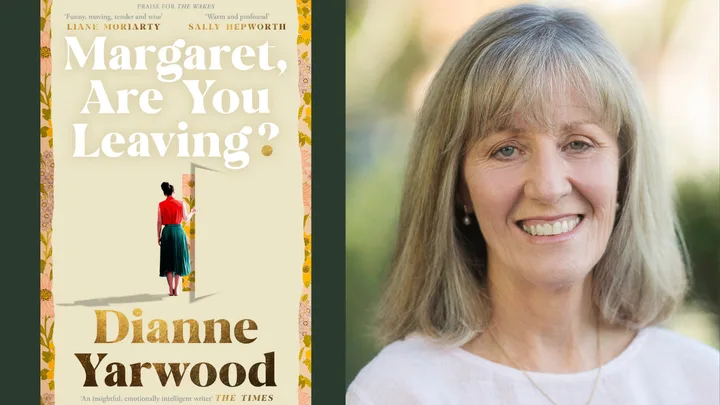
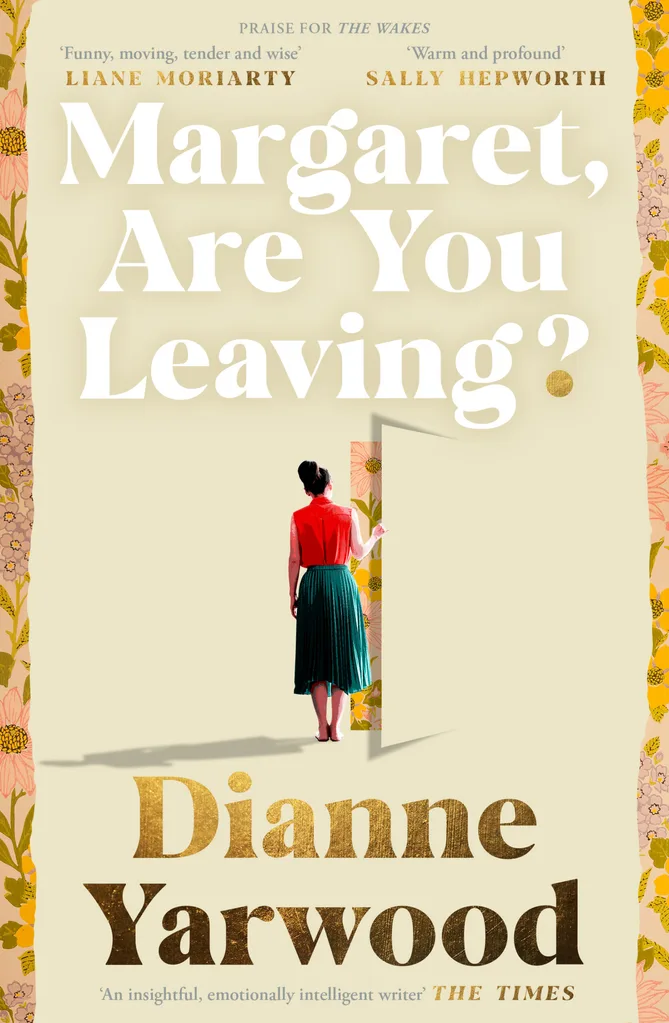
AWW: Margaret, Are You Leaving? is inspired by the life and history of your friend whose mother migrated to Australia after World War II and then left your friend when she was only seven months old. How did you come to tell this story?
Dianne: “I’d just finished writing The Wakes. I think all my friends thought it was quite an odd thing I was doing. I finished [the first novel] and I casually mentioned to a friend that I hoped someone would pay for what I was doing to give it some credibility or legitimacy. She mentioned it to the real-life Maggie and she rang me and said, ‘Would you like to write my story?’ I was just thrilled. We were in the same circle of friends without being close. But I knew she’d just started looking for some of the facts of her heritage, and her mother, in particular. There were some quite intriguing facts that had drawn me in so, I said ‘Yes’ on the spot. I don’t think I realised at that point the responsibility I was taking on, but I was intrigued by the mystery.
I sat her down, because even though we were friends I knew nothing of her upbringing, and really none of her friends knew much of her upbringing, and I came to understand that that was part of dealing with childhood trauma. You have to contain it in some way. Her way was to not talk about it at all. So I said, ‘Tell me about your childhood.’
We were in tears early on. It became a good thing for her, I think, to have someone who listened. Someone who said, ‘You’re story’s important.’
I was just stunned by some of the things she told me, and the way she constantly underplayed them. Like the story about the convent. I won’t say much about that because it’s a bit of a mystery in the book, but there were quite a few moments in her story where she would tell me something, and I would look it up and realise how much she had understated what she had survived or coped with.
It wasn’t just that her mother disappeared when she was seven months old, it wasn’t a happy story after that. The story breaks your heart, but it puts it back together again.
The book is a fictionalisation of the ‘real’ Maggie’s life. How did you build the world around the kernel of truth your friend shared?
I started writing it as a biography, but my publisher and I soon came to see that wasn’t really going to work. I’m a fiction writer. I haven’t written non-fiction before and it’s not where my real skills lie. I’m the sort of writer who talks to my characters in the shower and wakes up at three o’clock in the morning with a scene fully formed. I rely on that freedom. What I found with non-fiction writing is you’re so constrained, and that was not working.
Fiction gives you possibilities. It’s a very big story and to capture it’s size I had to turn to fiction. The amazing thing about my friend is she gave me the story without restriction and not once did she question me, or did her trust waver. She’s just a wonderful person.
It’s set in 2001, but the present-day Maggie character is fictional in my mind, but she is my friend in character. In how she reacts to things. Her childhood memories that surface in her present day are true. My sister rang me and said, ‘Please tell me that the story of the mother in that black car isn’t true.’ I said, ‘That’s true’. In part three of the book, we go back in time. All of that is pretty close to the truth. I’ve had to imagine the thoughts of her mother, in what she did, which is quite a stunning thing, but my imaginings were based on a lot of things I’d been told, and things I’d seen written. Such a large amount of the book is true.
One chapter in the book, chapter seven, remains virtually untouched by fiction. Why?
That section is untouched by fiction because of its gravity. I made a note in the book about Abbotsford Convent and its role in the story because I wanted to honour the victims. I didn’t want the survivors to feel that I had in any way used them for entertainment purposes in the story or to give the story colour. I wanted to honour what they had been through. Obviously, it’s to the best of people’s recollections, but it’s as close to the truth as I could possibly get.
The real Maggie’s identity remains a secret, even in your author’s note. Why is that?
I’m not sure that we had a discussion about not naming her but I felt instinctively that I didn’t want to. As it happens she’s become more and more comfortable with the process and is joining me for book events. She’s actually going to do quite a bit of publicity with me. She came to the launch. There are quite a few characters in the book who are still alive and who came to the launch. I thanked them in the acknowledgements again, but I didn’t name them. I just feel the need to respect people to make that decision themselves. But she will be honoured in person with all the events.
I am a worrier, but in my heart, I am in awe of her, so I always knew that would come out on the page.
One of the beautiful parts of the book is seeing the friendship develop between the characters Maggie and Anna. Did the writing process deepen your friendship with the real Maggie?
I can’t even start to explain what has happened to our friendship. It actually makes me teary even thinking about it. It’s a friendship like no other I will ever have.
As Maggie is learning more about herself, the parallel story of Anna and her mother unfolds. Tell me about why you included that story.
People say to me, ‘Are you Anna?’ I say, ‘Oh, no!’ But I think I might be in a lot of ways. I started writing Anna because Maggie did have a close friend who worked with her at a television station. Originally Anna had a much lesser role in the book. In one of the early edits, the editor said to me, ‘I think with Anna’s point of view, she deserves to be more than a witness.’ So I developed the Anna character and I could see how much that added to the book in terms of friendship, the value of friendship, and the importance of support when you’re going through something like what Maggie went through. The book celebrates our shared humanity and friendship is just crucial to that.
I said to a friend, when I was writing it, ‘When I say this girl’s name, [the real Maggie], what’s one word that comes to mind? She said ‘warm.’ That’s really what I centred on with the book because that’s a very incredible story of survival; to be that warm sort of person when you’ve known so much coldness. It’s quite uplifting, what you can do with your life.
A part of the book I really enjoyed was the post-World War II migrant experience that you capture so beautifully. Where there any other true stories that you came across in your research that you wove into the narrative?
Yes, it’s a crucial part of the book and I did do a lot of research, but it’s also based on truth. I would be told a story then I would research it to understand it better. But what I had to draw on was this: As we understand Maggie was raised by a Czechoslovakian couple, who came to Australia after World War II. As the reader will come to understand, most of the trauma in this book stems out of World War II and what war does to people. Maggie’s mother wanted to be a writer and she wrote all the way through Maggie’s childhood, to the point where they were quite neglected, the children. But obviously that was what she needed to do. After she died, I was a given a box of everything she had written. She wrote poems about the migrant experience, so I had that. I had letters from her friends, and I was put in contact with a Polish man.
He is quite central to the book. He arrives as a nine-year-old Polish boy in a town outside of Bendigo. He’s a bit of a star of the book and he allowed us to really understand his story. He actually came to my launch and that brought a lot of tears. He has an amazing memory. He also told me a lot about the migrant experience. His father was Polish. His mother was Russian and was dragged from her home when she was a teenager by German soldiers and taken to Germany to work for the entirety of the war.
What I wanted with the book was to make these stories real; to put you in these characters’ lives and thoughts.
What were the elements of the migrant experience you wanted to illuminate?
There’s quite a lot in the book about Bonegilla migrant camp. I did quite a bit of research on that to understand what that was like, because that was quite pivotal to a lot of migrants. That was their first view of Australia. So that was quite important to describe what it would be like as a European migrant to arrive in a dust-blown corner of Victoria in the middle of summer.
I was reading about your own writing career, and it struck me that there were similarities between what happened to you and what happened to Maggie in that you both had an incident occur that made you pursue something important. In Maggie’s case, it’s searching for her identity. In your case, it was pursuing your dream to be a writer. Can you share that story.
I was an English lover and voracious reader as a child but I was also very good at economics. My mother died when I was 17 and I very much felt like my safety net had gone, and I wasn’t a risk-taker. So, I ended up doing a commerce degree to get a stable job. I enjoyed it. I enjoyed the social nature of the places I worked. I went to London with it and then I met my husband and had children, so that dream I’d had as a teenager just sort of faded away.
Then, when I was 40, I became very sick. I had an autoimmune disease. It’s a very rare disease, Addison’s disease, and very hard to diagnose. I was sick for almost a year. It’s a gradual illness.
What happens with Addison’s disease is you have an event. You go into a kind of shock. It’s called an Addisonian crisis. That’s what kills you. I felt like we’d done everything. I thought I was dying but because I was so depleted, I didn’t rage against it. I was saved in emergency by an emergency doctor who had seen it before. The cure was to inject me with steroids, and I was well almost straight away. I started writing in my hospital bed. It was as if I knew I’d almost missed my chance. It felt right. I’d always felt like an imposter as an accountant. I will never stop being grateful.
This interview has been edited for clarity and space.
Read the book review here.

We seek out the best stories. We nurture them. Then we share them. Hachette Australia is a team of expert publishers and passionate readers dedicated to discovering and supporting talented writers and working with them to craft exceptional stories.

Related stories