



At a glance…
- Zoë Foster Blake’s latest novel, Group Chat, is a love letter to female friendship and the importance of making time for ourselves, particularly in midlife.
- The author reveals how losing a young friend to brain cancer inspired the book’s central philosophy: “F*** It, Book It.”
- Zoë also opens up about her own experience with perimenopause and HRT, and why she believes women need to have more honest conversations about midlife.
For many women, the idea of taking a few days away with their closest girlfriends sounds wonderful in theory. But between work, children, ageing parents and the endless demands of everyday life, actually making it happen can feel almost impossible. It’s something Zoë Foster Blake knows all too well, and it’s at the heart of her latest novel, Group Chat.
The bestselling author and entrepreneur has returned to fiction with a love letter to female friendship, exploring what happens when women in their 40s finally make time for themselves and reconnect with the people who knew them long before careers, marriages and motherhood took over.
But there’s a deeper drive to the central story. After losing a young friend to brain cancer, Zoë found herself confronting the uncomfortable reality that none of us knows how much time we have.
“I have to make the most of my life because she didn’t get to live hers,” she tells The Australian Women’s Weekly. That realisation helped inspire the novel’s guiding philosophy: FIBI, or “F*** It, Book It”. In other words, stop waiting for the perfect moment to take that trip, see your friends or do something purely for yourself.
But Group Chat also explores the less frequently discussed realities of female midlife, from the shifting dynamics of marriage and friendship to perimenopause and the feeling that somewhere along the way, you’ve lost a little of yourself. After navigating her own challenges with perimenopause and finding relief through hormone replacement therapy (HRT), she says she’s rediscovered not only her sense of self but also her love of writing fiction.
With two novels released in as many years after a decade-long break from adult fiction, Zoë is firmly back in her writing era. Here, she speaks with The Weekly about the friendships that sustain us, the midlife conversations we need to be having and why sometimes, the best thing a woman can do is put herself first.
Group Chat is your second novel in two years after a 10-year hiatus from writing adult fiction. What drew you back to writing novel writing?
I think I just didn’t have the mental bandwidth or capacity to write long-form because I had young babies and (inaudible) my business was really big, so instead I wrote non-fiction and picture books for about 10 years, which felt about right for what I could handle.
It wasn’t until my children were in primary school that I had the appetite and capacity to write long form again. I think Things Will Calm Down Soon felt urgent to me because I’d just been through a big process with my company, and selling it and so on; I felt I had to share that information while it was fresh, and I kind of wanted to give a lot of business advice through the form of fiction.
With this one, I feel like I’ve hit my stride again. It felt like pure fiction, pure fun, and I felt fit again at novel writing.
When promoting Things Will Calm Down Soon, you spoke about how important writing and communicating via the written word is for you. You said, “I was worried that I’d lost it”. Tell me about that moment?
“I think also because I had taken on such an ambitious project with that particular novel, which was really trying to infuse business advice and a novel that would still bounce along and be fun and interesting enough to carry you through. So I was trying to meld two quite different and distinct genres, which was maybe silly. But I just didn’t want to write a straight-up business book because there are plenty of those, and I felt just writing a novel wasn’t going to do it justice.
There was a lot in my brain, and I was literally in a deal in real life as well, trying to buy back my company at that time, so I had a lot of fiction and non-fictional stuff in my head. It was a confusing project, to be honest, but I think that bigness allowed me to go full-turn and go: shit, man, I really just want to write something fun.


What was the kernel of inspiration for Group Chat?
I’ve never really done a pure romantic plotline. All of my novels are really based around a very strong female friendship or a sister, because I find those relationships the most interesting and dynamic. So I wanted to write a love letter to female friendship, and building the narrative was second to that. Seeing all these women come out, with their friendship groups in their early 40s, and seeing how we finally reconnect after a decade or more of pulling away to have children and focus on career, and finding that these women that we’ve had decades-long friendships with, who know us and who have witnessed our life, just felt very wholesome and relatable and fun.
Early in the novel, you introduce this idea of ‘FIBI’: F*** It, Book It. Tell me about why that concept was important to you?
So FIBI is a phrase, F*** It, Book It, that is really the philosophical underpinning of the book, which is: you never know what life holds; book the trip; do the thing. I had a young woman friend pass away from brain cancer, and there’s nothing like that to really galvanise you and remind you that you’re not promised anything. It’s always someone else it happens to, but what if it was you?
And to, despite it all – because we’re never going to have a good time for a holiday – particularly, you know, busy mums with a lot going on in their life and perhaps an incompetent husband who can’t really – you know – all of these things come into play. We will make so many excuses not to go. I want the point of the book to be: make the excuse to go. Book the time. Honour your friends. Honour yourself, and do it. Because we women get no unstructured friend time. The minute we get a minute to ourselves we might, if we’re lucky and feeling generous we might look after ourselves. We might have a massage or a rest, but rarely will we go, ‘No, I want a couple of days with the girls to talk shit, scroll without guilt, eat and drink whatever we want and rest together.’
My girls don’t really do a lot of resting in the book, but they’re together, and that sisterly closeness that they feel, I just love it. I love the girls in the book so much, and they’re very intentionally written to be archetypes of different personality types that we might come across in our lives.
I’m so sorry to hear you lost a friend to brain cancer.
Sadly, I think a lot of us know someone who has passed early, and it does; it just wakes you up. I think you can go one of two ways. You can really get deeply sentimental and sad; for me, I felt a rage, and I felt electric. I have to make the most of my life because she didn’t get to live hers.
We meet the friends at a crisis point. The notion of the male midlife crisis is so familiar that it’s a cultural cliché. Why do you think the female mid-life crisis is unexplored or underexplored?
This is a big question. I think because we’re endlessly competent and we just get on with it. The system supports us putting others first. The idea of putting ourselves first, to have a mental breakdown in the middle school runs and sick parents and house renovations just feels absolutely untenable. You’ve heard the term quietly quitting your marriage. The tone of perimenopause is quite strong in this book too, which is something I felt really deeply. I think it’s something a lot of women in this age bracket, knowingly or otherwise, are in. That really causes you to reflect, and it causes you to be really annoyed with your husband, whether he’s a cupcake or a shit. Because your oestrogen’s dropping. You’ve got real, hormonal reasons for not feeling like yourself, and for feeling constantly irritable and a bit – you know, the ennui of boredom. Is this what I thought my life would be at this stage?
I really like that journey for Stella because I think it is under-spoken-about. I don’t think we are talking about it enough. It needn’t be this catastrophic; I’m having an affair with my personal trainer and blowing up my life. Women, I think, often internalise it for a lot longer and try to solve it, fix it, personally or with their friends before they do anything. I love the relationships and conversations she has with her friends about this, and they pull her into line. They’re really honest. They love her. They’re way past politeness.
You describe it as a fun novel, but you do sneak some serious conversations in, one of which is about HRT. Why was that a conversation you wanted to have with your readers?
I don’t think it’s discussed enough, despite there being some really brilliant advocates in this space. I just seem to be having the conversation again and again with women about what it is and dispelling myths and flawed ideas that linger from 20 years ago. I personally went through a few big years of not feeling like myself, finding a specialist who put me on HRT, and just feeling like myself again.
I often say that Things Will Calm Down Again Soon is me unmedicated, and it was a very anxious, stressful, full-on novel, and this is me on HRT, back to having the capability to write fun and comedy and being able to step back a bit rather than feeling in it and unable to get out of the fog. I’m not trying to be prescriptive at all, but just trying to alert women that you’re not alone. This could be happening to you, and sort it out because it doesn’t have to be this way.
Is your fiction break over? Will you write more novels?
Yeah, I don’t have a call for non-fiction currently. It’s just whatever’s in my world and my mind and my heart. I’ve got a few directions I want to go in for this next chapter. I have to get this tour done first, but I feel I just want to push myself and challenge myself in new ways. And what that looks like, it could be writing for stage, or screen, or something like that because I do really love dialogue. I feel like I’m back in the flow for sure, but I get bored quickly, so I’m like: What’s new? What else can I try?
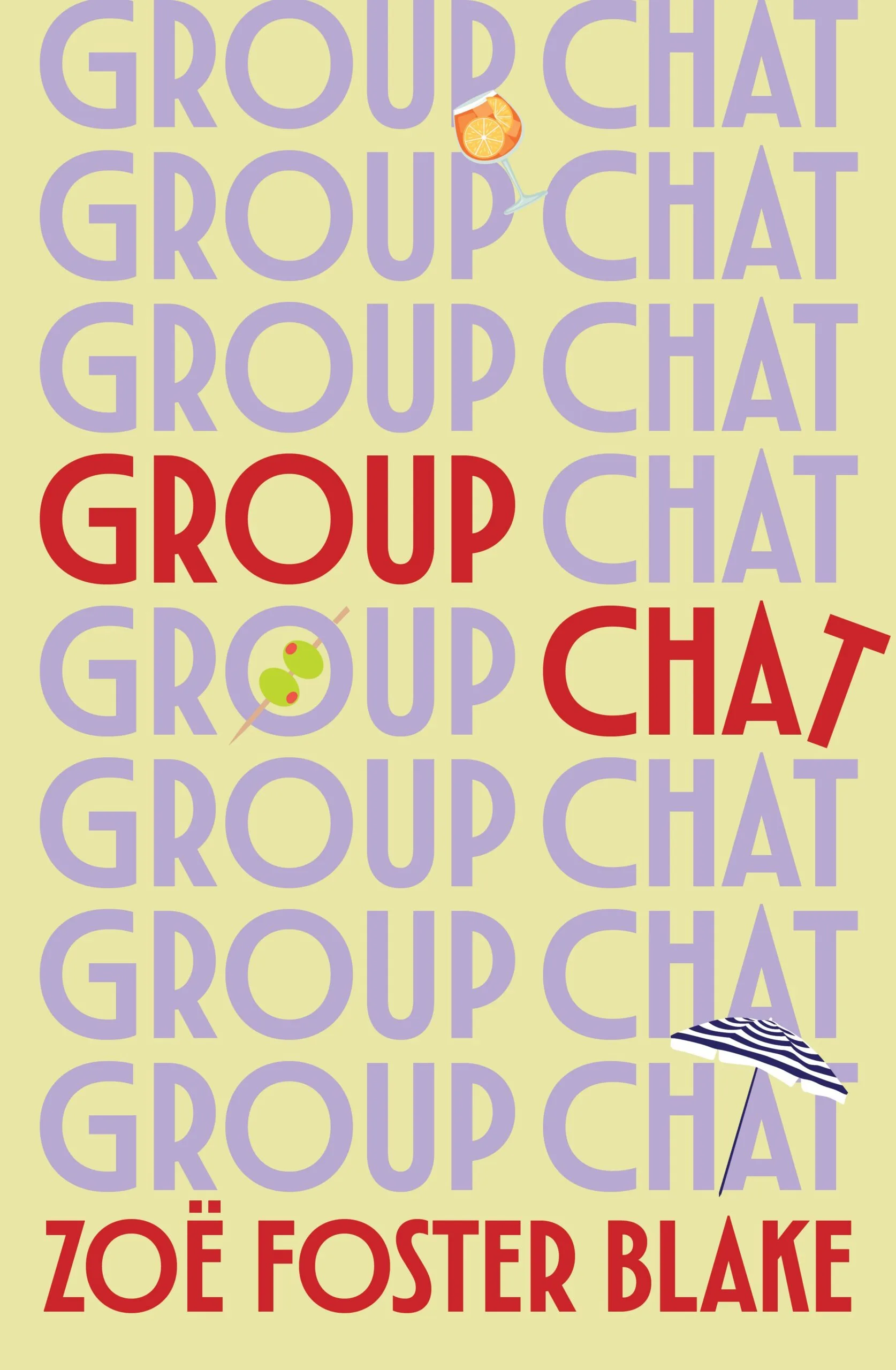
Group Chat by Zoë Foster Blake is out via Allen and Unwin on September 29.

