




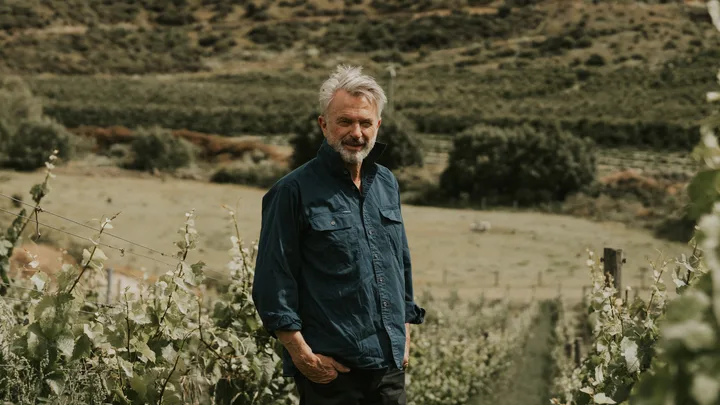
Back in 2021, Sam Neill invited The Weekly for an exclusive chat and photo shoot on his wild and windswept Central Otago farm. With the sad news of his death in July 2026, we’re revisiting the story below.
When Sam Neill left his vineyard in the Southern Alps of New Zealand to work on the Apple series, Invasion of Morocco, last February, he could not have anticipated how long it would take to get home again. Or what was to follow when the production shut down. That borders would close, and the world would stop, that there would be a season and a vintage on the vineyard he would not see. And he certainly didn’t plan on becoming a sort of kindly global uncle amusingly reassuring anxious, uncertain people as the pandemic spread and lockdown became the reality. To his half a million Twitter followers, there he was playing Radiohead and Randy Newman songs on the ukulele, reading poems and children’s books, duetting with Jeff Goldblum on jazz piano and bringing us Cinema Quarantino; comedy short films with his friends David Wenham, Hugo Weaving and Helena Bonham Carter.
This social media star who suddenly popped up in the crisis came as a surprise to those who know him, including his son Tim, who describes him as “such a private and reserved person”. It wasn’t a Sam Neill that his friend of 33 years, Rachel Ward, had seen before either: “He’s actually quite a shy, retiring man in many ways, but he’s completely embraced it and invented this wonderful sort of avuncular character that is sending messages out there to try to calm the populace and to encourage them to stay home.”
When he finally makes it home to the vineyard in December, he recalls those early days of lockdown when some kind of alter ego took him over with a bemused fondness. “It was very, very uncertain,” he tells The Weekly. “And I realised people were very frightened and alarmed and isolated. And I thought, you know, if I can cheer up one person, that’s probably not a bad ambition. But mostly I was just sort of entertaining myself, I think. I’m easily bored.”
Now 72, Sam is still in such demand that, unlike most actors, he is never out of work or has the kind of downtime he was forced into during lockdown, which he spent stuck at his house in Sydney, after flying back from the UK.
Rachel believes that he actually needed the comfort he was giving other people. “I know what’s behind that image, of course,” she says of her long-time friend. “And he’s probably done it because he feels that he needs it as much as everybody else. So he became that character out of necessity. He certainly needed to play a role, play a constructive role and play a creative role, which is what he managed to find as an actor. It’s the communication with an audience – he’s done it his entire life – and it’s just funny how he spun different ways to express that. However much you shut the lid on him, say, ‘no, you can’t perform now’ or ‘you can’t be on a film set’, he’s going to find a way to connect with his audience.”
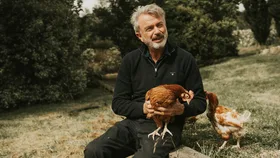
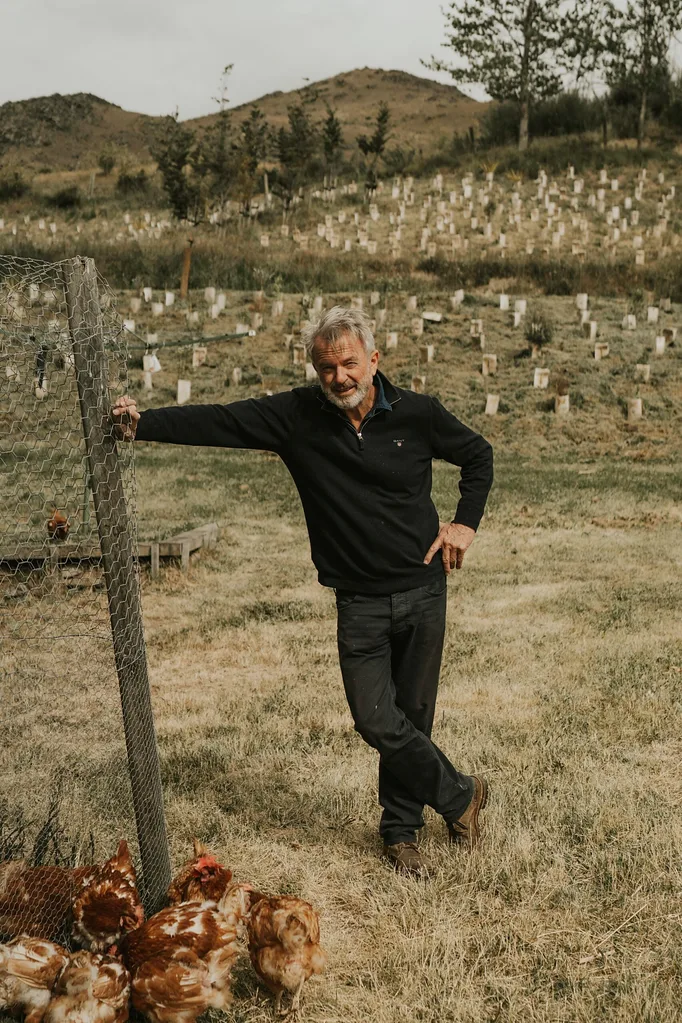
When we speak, he is in quarantine – again – in a hotel in Auckland. Soon after our interview, he will be posting about the ten newly rescued chickens who have arrived on the farm to join his now internet-famous animals, all named after his movie star friends.
Sadly, his beloved Muscovy duck Charlie Pickering died in the winter. “She was a superstar celebrity,” he says. “I’ve three more, and I’m going to get at least one of them to bond with me, if it’s the last thing I do.”
He is also looking forward to meeting what was a puppy and is now a full-grown dog. “We still haven’t met, so that is the first order of business – dog bonding.”
He is home at last and very happy about it. “To be in a safe little corner of the world like this feels like an enormous privilege,” he says.
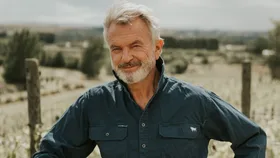
His vineyard, Two Paddocks, is a parallel universe to his life of red carpets, cameras, fame, all the things that come with being a movie star. Here he is, a winemaker, a producer of world-class Pinot Noir, a farmer.
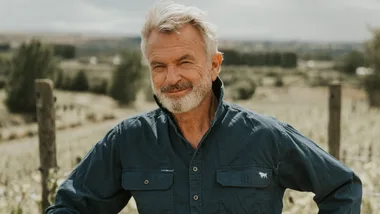
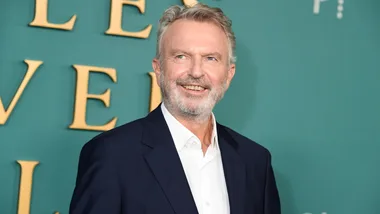
“I feel like I am part of the soil,” he says. “I love the whole process and the changing of the seasons.” In Central Otago, among the great snowy mountain ranges, steep gorges, deep icy lakes ringed with weeping willows and rock escarpments, the rows of grapevines spread out like green corduroy. “When I wrap a film, I plunge back into life on the farm with my people here, with the animals, vines, the landscape. And the annual rhythm of winter, growth, harvest, fermentation. I think one is kind of a relief from the other; they are completely different worlds,” he told me once in an interview for The Sydney Morning Herald.
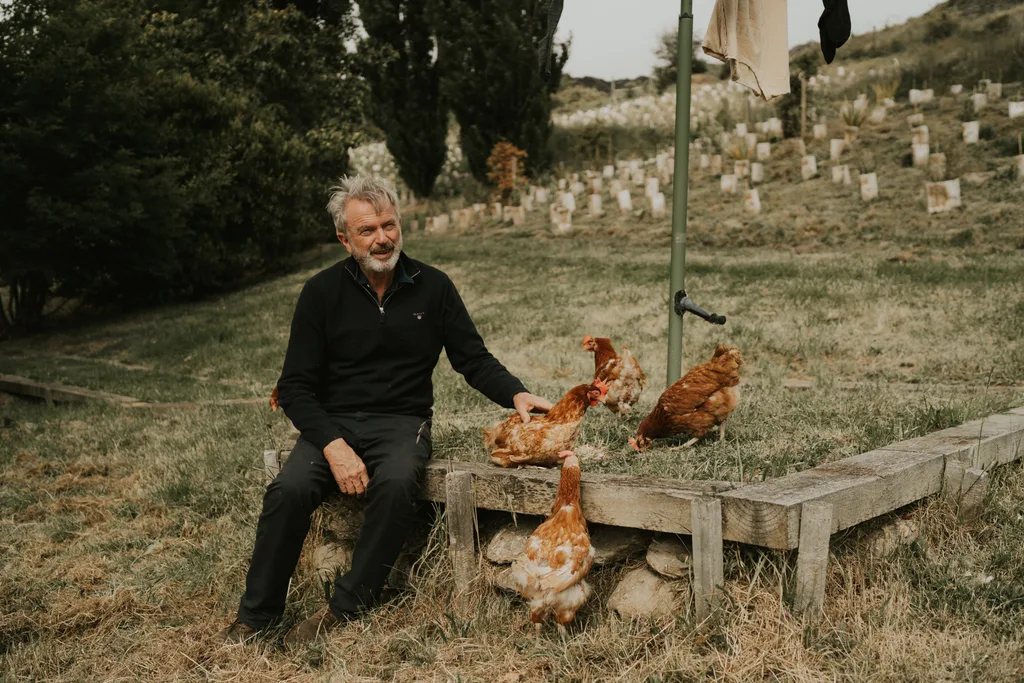
Central Otago is a place he has loved all of his life. A place he returned to as soon as he had some movie money. “When I first got a little bit of money from acting the first thing I did was buy some land in Otago. One of the things that I’m thankful for – for the career that I’ve had – is it means I’ve been able to buy land and grow things. That’s been a great benefit.”
This was a place where he had been happy as a child who had been sent to boarding school at the age of nine. “I think at nine years old you really should be still at home,” he admits. But holidays in the mountains were the shining moments that the little boy never forgot.
“So much of what you do in life is affected by your early life,” he explains. “My mum and dad were outdoors people, really. They loved brisk walks and getting on a horse; they loved fishing and camping. And so we’d go on these holidays and I remember us kids ungraciously grumbling a bit because all you want to do is lie around and read comics. We always camped – we never had a holiday house or anything like that – so we’d find ourselves in some pretty remote places, undiscovered places. We would find a bay on a lake or upper river and not see any other living person for days on end. It was just fantastic, they are some of my best memories and I’m really grateful to my parents that they made us do these things.”
His father was a New Zealander who was sent as a child to boarding school in England and became a Major in the Royal Irish Fusiliers, serving in WWII. Sam was born in Northern Ireland and not long after, Major Dermot returned to New Zealand to run the family’s wine importing business, Neill and Co, which had been operating since 1860. “I have been bathed in wine since birth,” says Sam.
“His mother, Priscilla, was very beautiful and a wonderful gardener,” says producer Margaret Fink, who discovered Sam for My Brilliant Career, the film that launched him and Judy Davis internationally in 1979.
British Priscilla had earned a place at Trinity College in Dublin, but her widowed mother did not have the funds for her to go. “She was a wonderful horsewoman,” says Sam. “She was a great amateur jockey back in the day – no one could beat her in point to points. She knew no fear, she understood horses, she bred horses, but domestic things were of no interest to her. She was a terrible cook, she made no bones about it.”
Priscilla went with Sam to collect his OBE in 1991. And he was able to tell his dying father, who had always hoped he would get a real job: “I think he was very taken with that. We both joined the establishment, just in different ways.”
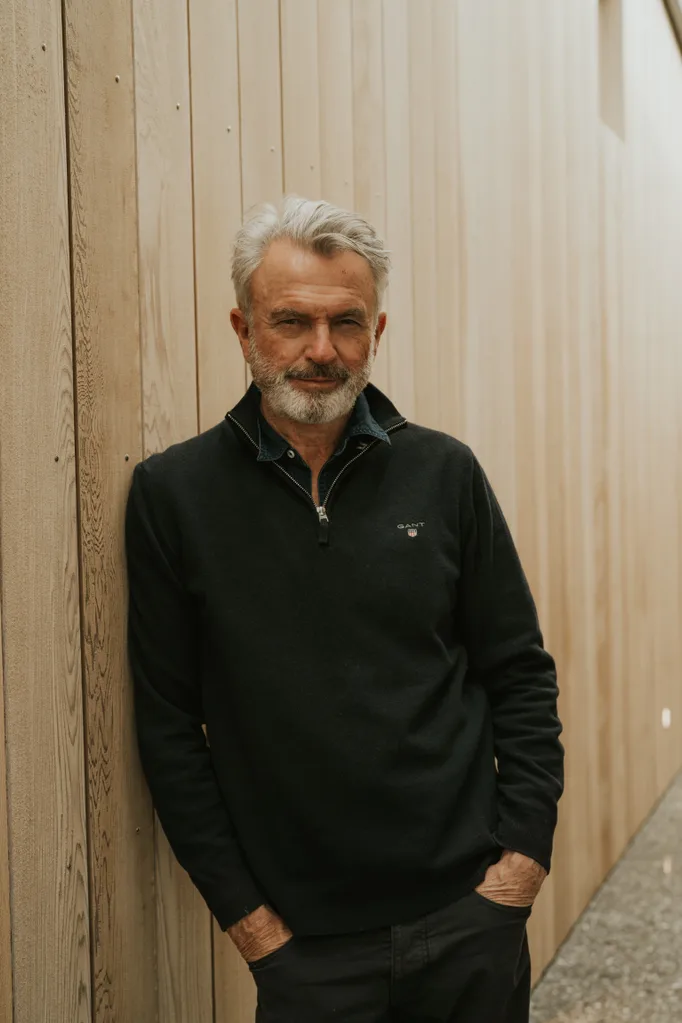
Being a plummy, upper-middle-class British boy in the New Zealand boarding school, Medbury, Sam was bullied. He stuttered; he was extremely shy and quiet. He was, he told Australian Story, “in the shadows quite a bit, observing people. And I think that stood me in good stead.” His brother Michael, an emeritus English professor, believes this may have been when he first began disguising himself, acting. Back then he was called Nigel, but decided that he really wasn’t a Nigel; he was a Sam. The name Nigel has been an ongoing joke over the years.
The Anglican Christ’s College, where he went to secondary boarding school in Christchurch, was known as a bastion of New Zealand privilege, the poshest school in the country.
“Look, there’s pluses and minuses to all these things,” he admits. “If nothing else, boarding school teaches you resilience; it teaches you to be self-sufficient. I’ve spent a lot of my life in hotels, away from home, with that sense of isolation, so boarding school came in handy. It teaches you how to make friends, actually, and I very much value my friendships.”
Rachel’s husband, Bryan Brown, is one of his great friends. Rachel has known Sam since 1987, when she and Bryan worked with him on The Umbrella Woman. He and Bryan are often howling with laughter, says Rachel. “They seem to find each other hilarious.”
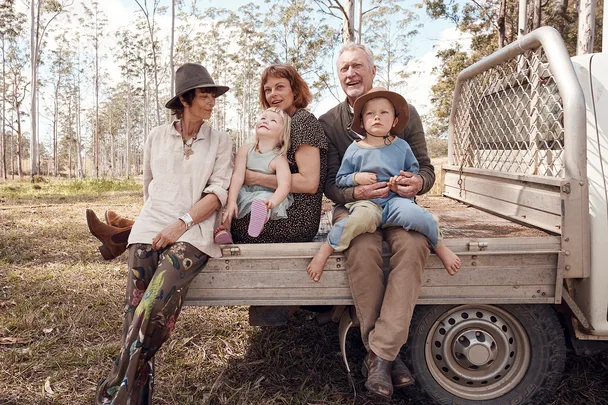
But she says, “They’re Laurel and Hardy; they’re just so different. And in a funny way, I think he is a male version of myself in regards to our relationship with Bryan.” Bryan, says Rachel, is pragmatic, working class, practical. “Bryan is like the father figure. Whereas we are emotional, spontaneous, sometimes irresponsible.”
Bryan delights, says Rachel, in “Sam’s style, humour and imagination. Sam is certainly more aesthetic than Bryan. He creates these worlds; he will just go with this fantastical idea. Bryan respects that Sam can do that, that he is a very visual person, very creative. Bryan can hold worlds and threads together; Sam has got more of a sort of whimsical, imaginative, childish quality.”
Sam seems to be a man for whom everything has come easily. Born lucky, a golden boy, he makes it all look effortless. Clever, handsome, charming, and just a lovely man to be around, he is always inclined towards humour and wit.
Says Rachel: “He has an extraordinary facility as a public person. He just is so winning, and he’s got charm. He’s really got that… But you struggle with that knowledge and in a way that brings its own insecurity. You know, underneath he’s quite insecure.”
You would never think he was an actor, his son Tim told Australian Story, “because he is the least dramatic person you will ever meet.”
Those who know Sam describe him as modest and self-effacing. When Rachel directed him in Palm Beach, she found out just how true that is. She wanted him just to be himself, but she says, “he is quite uncomfortable doing that – it’s much easier to hide behind character. He is always trying to disappear behind someone else.”
Sam’s acting career was almost accidental. After graduating from Victoria University with a degree in English literature, he became a long-haired hippy documentary maker for the New Zealand Broadcasting Unit. He had done a bit of acting at uni and was interested, but there was no film industry in New Zealand. Then, in 1977, director Roger Donaldson cast him in the action thriller Sleeping Dogs – the first colour feature film produced entirely in New Zealand. The film came to the Sydney Film Festival, where it was seen by Margaret Fink and Gillian Armstrong, who had been on a long search for Harry Beecham, the romantic lead in My Brilliant Career. As soon as he opened the door to her, Margaret knew she had found her Harry, even if he badly needed a haircut.
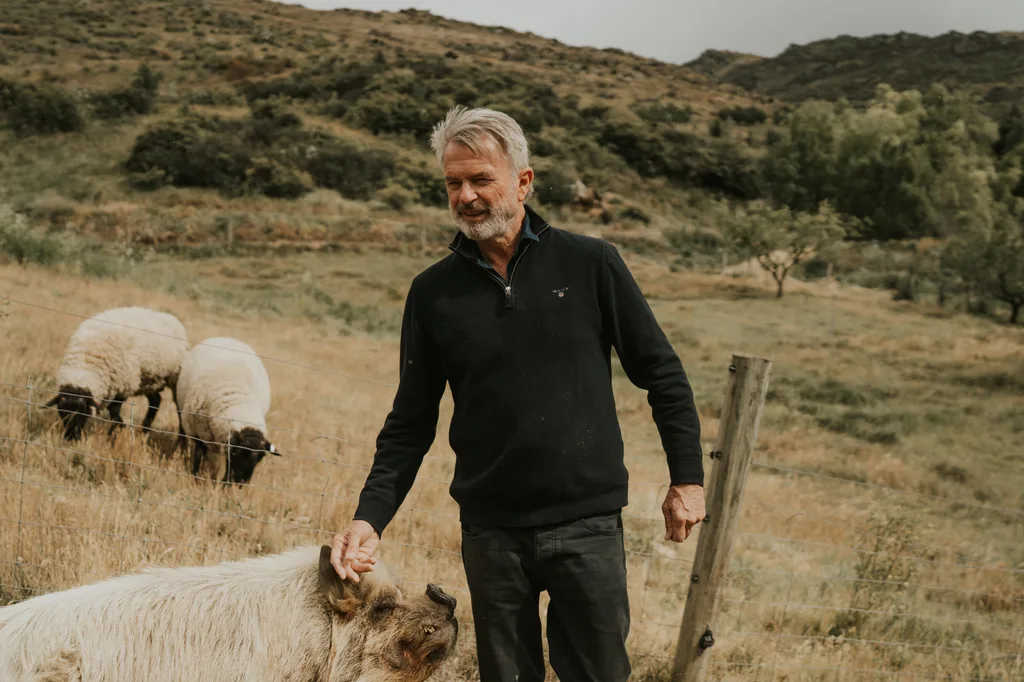
For Sam, it was the beginning of a long love affair with Australia. My Brilliant Career would launch the careers of everyone involved. “It completely changed my life,” says Sam.
His ascent was meteoric. Soon, he was in London being the Antichrist in The Omen 3. There he met Shakespearean actress Lisa Harrow (Tim’s mother), with whom he had a 10-year on-and-off relationship.
Then came the Hollywood blockbusters Hunt for Red October and Jurassic Park. But he was never comfortable with the Hollywood star system, the lack of privacy, the inflated egos and the divorce from reality. And he always returned to Australia to make seminal films like Jane Campion’s The Piano and Evil Angels about Lindy and Michael Chamberlain, co-starring Meryl Streep.
In 1987, on Dead Calm, starring Nicole Kidman and directed by George Miller, he met the make-up artist Noriko Watanabe. “It was on an island with plenty of time on our hands, so I leapt out in pursuit of her. I met with tremendous resistance for a long time. I got there in the end with dogged persistence,” he told The Guardian in 2006. After they married, he adopted her daughter, Maiko Spencer, and they had their own daughter, Elena. In 1994, he met a son he had fathered in his twenties who had been adopted and who also became part of the family. Because of his constant travel, he jokingly described his family life to Australian Story as being “somewhat haphazard” and his parenting as “benign neglect”. But his six grandchildren, Tim insists, bring him a great deal of joy.
When his marriage ended in 2015, Sam was on his own for “quite a while”. But in recent years, he has been in a relationship with ABC chief political correspondent Laura Tingle. It is strictly private, but he did tell Australian Story that it is something he is “grateful” for, and joked: “My guess is that I’m in it for the politics; she’s in it for the wine.”
When he and his then very excited 10-year-old son Tim met Princess Diana at the London premiere of Jurassic Park in 1993, it had already earned $200 million and was the most successful film of all time.
Twenty-seven years later, the dinosaurs are even more enormous than they were the first time around. He has just spent four months in the UK filming Jurassic World; Dominion with original cast members Jeff Goldblum and Laura Dern.
“It was an extraordinarily ambitious production and expensive. We had something like 129 different sets and we had all these animatronic dinosaurs, just immense incredibly sophisticated dinosaurs of one kind or another that do all kinds of wicked things. It is a very big, very ambitious film,” he says.
Lately he has been doing a lot of crusty old men in seminal box office hits like Hunt for the Wilderpeople, Ride Like A Girl, Sweet Country, Peter Rabbit, and most recently Rams, opposite Michael Caton, who he had last worked with in 1979 in The Sullivans. “Some of the regular cast were a bit too important to actually talk to you, but Michael was lovely and sort of took me under his wing,” he recalls, adding: “I get asked to do a lot of Dad roles but actually I think I am the go to for Granddads now. Crusty is fine.”
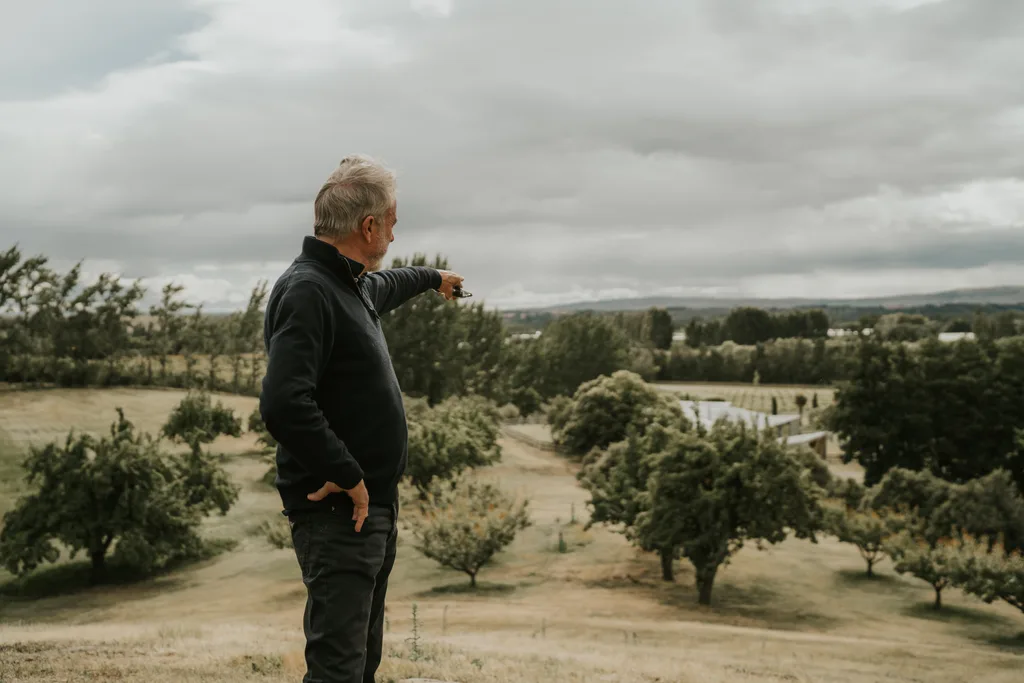
And anyway says Rachel, crusty, “is very far from who he is. He just seems to get better and better looking.”
Rams was the third of three films he worked on back to back, including Palm Beach and Blackbird. “By the end of Rams I was exhausted. My character’s house had a spare room, and in between shots, I just had a bit of a lie down – I didn’t even have the ability to take my boots off – I would just try to get my energy back.”
Sometimes, these days, he says he finds himself “shuffling” to the bathroom. “I think, why are you shuffling? You are walking like an old man. Stop that. Stride purposefully towards the shower, stop it now.”
As he gets older, he says, “I am sort of very conscious of living in the moment and making the best of the day. Somebody gave me some really good advice a few years ago in New Zealand: Don’t let the old man in.”
He has said, in the past, that acting has to come from a place of truth, but is it possible to be truthful while pretending to be someone else? Sam tries to remember what he was getting at when he first said that:
“I think someone said, you know, ‘what’s it like lying for a living?’ And I rather took offence at that, because it’s like you are truth-telling if you’re acting correctly. You should be truth-telling about the human condition or telling the truth of what you’ve observed about human behaviour. If you’ve really done your work, you should be telling the truth about that character. It’s an odd idea, given that you are sort of faking something. But actually, if it’s any good, it’s not fake – it’s meant and it has a core of truth.”
At 72, Sam Neill has reached some kind of third age where he is more vital and popular, busier and more creative than he ever was. And that is saying something. It is more than ageing with dignity, kindness and equilibrium, it seems a place of wonder and delight. And all those things that he is –the self-effacing amateur ukulele player, the lover of nature, the rescuer of mistreated animals, the consummate performer – we’re fortunate that he’s chosen to share them with us.
The article originally appeared in the January 2021 issue of The Australian Women’s Weekly. Subscribe so you never miss an issue.

