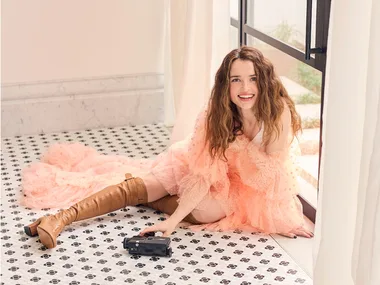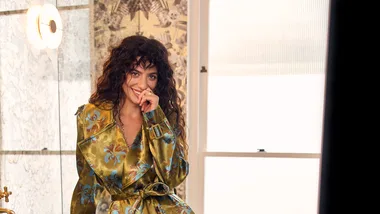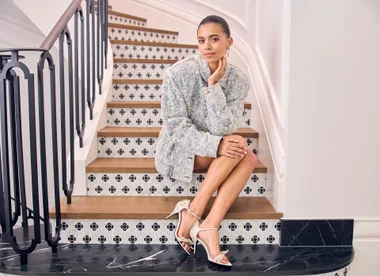




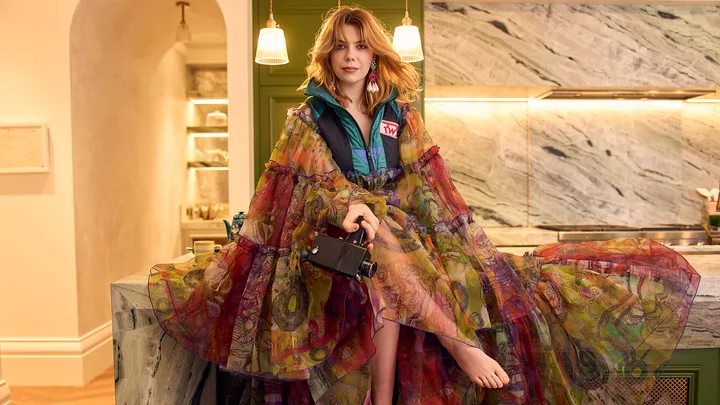
Before you ever see Sophia Wright-Mendelsohn on screen, there’s a good chance you’ve already heard her.
Long before screen credits, before film festivals and horror villains, there were voices, accents slipping in and out, characters forming mid-conversation, impressions woven into everyday life. “I think I started doing voices at like a really young age,” Sophia Wright-Mendelsohn says over a video call, both of us perched over our laptops as we discuss her origins in the industry. “I think it was, in all honesty, like a… like an anxious kind of thing. Like I just started doing voices.”
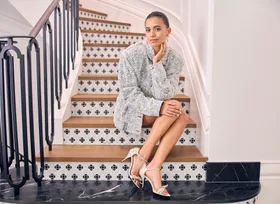
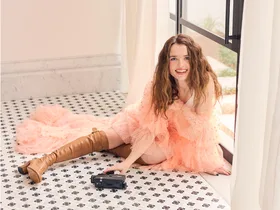
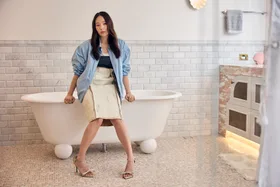
What began as instinct became craft.
“As I got older, I just found myself mimicking cartoons; that was just a really big thing for me.” Then came the revelation that would turn play into a profession: “When I found out that you can make money from it. That was so exciting.”
Voice work wasn’t initially part of a grand strategy. A friend mentioned agencies that specialise in voice acting, and suddenly, a private habit had a public pathway. “It was kind of something I hadn’t really considered, and then was like, yeah, my God, let’s look into that. And then I started. So much fun.”
Today, voiceovers make up a major part of her creative life. She rarely recognises herself when she hears it. “I also don’t really recognise my voice when I hear back,” she admits. “In my mind, I have like… blank sheet of paper voice. It could be anything.”
That “blank sheet” is exactly what makes her so good at what she does.
Today, Sophia has built a quietly robust voice career alongside her screen work, delivering commercial spots, radio work and character pieces that showcase a startling versatility. But she’s the first to admit the two disciplines feel worlds apart.
“I think they’re definitely very different… Screen acting is working with other people. Voice acting is in its own world because it’s me in a booth with these prompts, and I have to pretend that I’m super excited about something with no eyes to look into… It’s just words on a page, and I have to create a world inside a dark box that elicits that kind of feeling in my voice.”
In that dark booth, there is no co-star to react to, no costume to slip into, no set to anchor the moment. “It’s just words on a page, and I have to create a world inside a dark box that elicits that kind of feeling in my voice.”
For her, that isolation makes her voice work harder. “I think voice acting is really much harder. I think it’s much harder.”
And yet, she loves it.
“I love it. Voice work is so cool because it pulls on imagination so much.”
Without the scaffolding of a physical environment, she must manufacture it entirely in her head. “It forces you to access imagination that is so specific to voice work.”
If screen acting is collaborative, voice acting is internal. “Acting with people is all about them. Voice is all about me.”
That duality, outward focus versus inward creation, seems to mirror something deeper in Sophia’s personality. When asked whether performing began as a form of protection, she nods toward the idea. Voices, she suggests, were both self-soothing and socially connective.
“Oh God, yeah,” she laughs at the idea that it entertained people around her. “I think it’s a great little system I’ve created because I’m really safe and the people around me generally are having fun.”
There is something disarmingly honest about the way she describes it: performance as both self-care and offering. “I think that’s why I also love acting so much, it’s rooted in this self-care thing that I’ve procured at a young age.”
On screen, that instinct has translated into a series of diverse roles. Unlike many of her peers, Sophia didn’t come through a formal drama school pipeline.
“I’ve never gone to school,” she says matter-of-factly. “I did like classes… sporadically during my life, but I didn’t have the kind of toolbox that people who go to school really hone, you know?”
Instead, she’s been building that toolbox in real time, role by role. Her most recent project, the horror film Penny Lina’s Dead, was a turning point.
“It was the most creatively fulfilling thing I’ve ever done,” she says. “It premiered Adelaide Film Festival… the character was so, so far from my reality in my set of circumstances, that was just… I’ve kind of had to learn how to act.”
And the character? “She’s deeply, deeply horrible… I’m playing the villain, and she is just objectively horrific.”
To portray someone so far outside her own moral compass required rigorous research and internal excavation. “She does some things that are very south of my moral compass.”
But she relished the pressure. “How the f*ck am I gonna pull this off? Like, I don’t know, but we’ll see.”
There is a thrill in that uncertainty, the same adrenaline she compares to real-life stakes. “It’s like the same pressure of like, Oh my God, how am I going to pay rent this week?”
Whether she’s playing someone close to herself or wildly different, she sees value in both. “They have their respective pros and cons.” Bringing more of herself can be freeing. Building someone entirely new can be electrifying.
She’s been fortunate, she says, to work with directors and writers who give her space to experiment. “They’ve essentially given me their blessing to have a lot of freedom and a lot of fun with the people they’ve written.”
In an industry she describes as “difficult” to “penetrate,” she finds joy in collaboration, especially with emerging filmmakers. “Up-and-coming directors are so exciting.”
Despite inhabiting so many fictional worlds, Sophia feels no longing to escape into them. When asked if she’d choose to live in any of her characters’ universes, her answer is immediate.
“Nah, I’m good. I’m good where I am.”
That groundedness extends to her ambitions. She dreams not of prestige drama but of magic.
“Oh my God, I really love, love, love, magic movies. I would love to be like a witch or a fairy, or like some horrible goblin.”
Or perhaps something underwater, she’s already dabbled in submerged performance. “Yes, I did once do underwater acting… It was fun.”
And if practical stunts are involved? Even better. “Attach me to a rope and swing me into a wall… That is so much fun.”
Looking back, her advice to her younger self is simple and grounded. “Just be ready to really work.”
The glamour of “calling dressing up work” is real, she acknowledges, but so is the difficulty. “It can be really difficult.”
Still, she offers reassurance to the girl who once hid behind impressions. “Trust yourself, but as you got it, you’re fine. You’re going to be fine.”
As for her voice, her instrument that launched so much of this journey, when she steps into the voice booth, she has a “blank sheet of paper voice. It could be anything.”
In the dark, in front of a camera, suspended by a harness or submerged underwater, Sophia Wright-Mendelsohn keeps finding new ways to shape sound into story and imagination into identity.
She is not just lending her voice to characters. She is discovering her own.
An excerpt of this interview originally appeared in the March 2026 issue of The Australian Women’s Weekly. Subscribe so you never miss an issue.
Check out the rest of our leading ladies: Miah Madden, Mia Morrissey, Philippa Northeast, and Yerin Ha.