



 Credit: Jen Bradley
Tell me about the inspiration for setting a story in a second-hand frock shop?
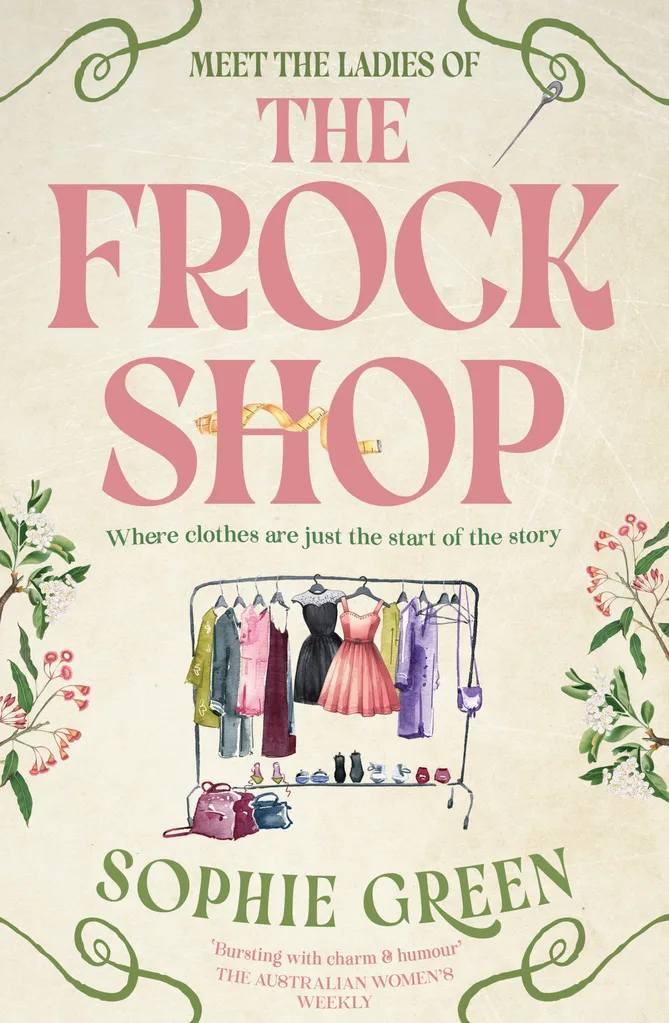
As is sometimes the case, I realise after I’ve had inspiration for a book that I had a spark of it years ago and had forgotten. The spark for The Frock Shop came when I was in the Lifeline shop in Cremorne. There was a woman who had been working there for a long time, and she’d worked in fashion. She’s pretty fabulous. She would style people as they would come in. I was pottering around, and she said, ‘Oh Darling, let me see how that would look on you.’ As I walked out of the shop I thought I wonder what she would have seen working in that shop.
After I’d started to make notes for that, I remembered that years ago I’d written down an idea for a similar sort of story set in a boutique in Rose Street in the city.
So, I’ve got this initial storyline, which is often how it starts. Then the first character who comes to me gets the first chapter. So that was Daphne emerging with that particular story. Then I thought about where I wanted to set it and I’d mentioned Mosman a bit in Art Hour at the Duchess Hotel and I’ve lived here most of my life. I love it and it’s beautiful and because of the geographical nature of it, you can draw a line and say, ‘That’s Mosman.’ It makes it a small community which is useful for writing ensemble cast fiction, because if you have people flung over a city it’s harder to bring them together for things.
So, once I had Daphne it started to unfurl from there. There’s a secondary character, Ophelia, who appears in the first chapter, who was definitely not there in the planning. I started writing that first chapter and out pops this woman called Ophelia Pankhurst with a very particular way of speaking and I thought, ‘Well, where the Hell did you come from?’
Sometimes it’s just that weird thing where the characters start to boss you around and reveal their stories, and I always just go with it.
Are you a thrifter? What is the best item you have ever come across in a thrift shop?
I am partly a thrifter. I also like to buy new Australian clothes, but only from a small number of people. I’m pretty particular about it and I choose people who make their clothes in Australia, like Carla [Zampatti].
Something that is not a red-hot item, but is something I still love and wear, is from Vancouver. I lived there a while ago and I worked in a bookshop. I did some volunteer work at a radio station and wrote about music. Vancouver has a great thrifting scene. There was a place there called Value Village that everyone would talk about and there was a little thrift store near me, and they had a V-necked jumper [with] embroidery on it. It’s got all these things to do with Palm Springs. The woman at the shop said, ‘I think that’s for a man.’ But it fit me perfectly. I wear it a lot and I love it to bits.
These days I’ll do thrifting more on Depop and eBay because I’m looking for specific things, but I’ll still go into the Vinnies and the Lifeline in Mosman and have a look around.
The book is peppered with vignettes about the lives of clothes. A moss-green jumpsuit made by a young woman who went on to become one of Australia’s most famous designers in particular captured my attention. Did you draw-on true stories for that or any of the other ‘frock stories’?
The frock stories that are interspersed throughout the book were actually the suggestion of the publisher, Rebecca. The houndstooth suit, which is the first one in the book, came out really quickly. That appears to be something people are really responding to.
With the moss-green jumpsuit I didn’t know until the end that that’s who it was going to turn out to be making it. I was just writing this story about a teenage making it and I got to the end and it just came out. But I did think the first efforts of a lot of designers are probably out there somewhere.
I remember reading the Zimmermann sisters were selling from Paddington market for quite a while, so there would be people with early Zimmermann. I remember buying Lisa Gorman’s very first Thai fisherman pants that she used to do. They were in some boutique in Newtown, and I thought they were great and had no idea she would go on to become Gorman.
The one story that is based on reality is the tan suede jacket. That was based on a jacket that was given to me when I was at uni and the young man mentioned in there dying was someone I knew. His father has just died so that’s why I wrote that story, in honour of his father who is also mentioned. It’s not an exact match, but I wanted to honour them both.
Tell me about the decision to give every woman in the story a creative drive, from Adelaide the cellist, to Daphne with her drawings, and of course Lucy. Why is it important to you to celebrate art and creative expression?
I think it’s something that’s come through my own creative practice but it’s also something I’ve learnt from my yoga teacher. I’ve been practicing yoga for a very long time. I’ve been teaching since 2002, and my yoga teacher has done a lot of work for years around creativity. It’s about drawing creativity from the body. She’s very interested in dance. Her contention, and I think she’s right, is that we’re all inherently creative. It’s just that social structures limit us or repress us, and particularly women.
We can see through the Renaissance the painters who are known and the playwrights who are known are all men because the women were running the household. They would have all been creative, they would have all said something to say and express. So partly what has evolved through the novels is this idea to just make something. Just express something. It doesn’t have to be refined. It doesn’t have to be for anyone else, it can just be an expression. I do think it’s an inherent part of being human.
My next question was going to be ‘Do you think everyone is creative?’ It sounds like you absolutely do, and you want to remind people that they are creative.
It’s that thing about giving ourselves license to do it. I think there’s a belief that it has to be “worth something”, and it has to be something people will pay money for. That’s not what the nature of creativity is! It can end up being that. But for everyone who has something that is for the public, and is for sale, there are many other things that nobody ever sees. I don’t get to the point of having a book out without having a whole lot of other things that nobody else sees.
There are a few budding romances in The Frock Shop. Yet these relationships are given less prominence and less importance than the female friendships. What did you want to say about female friendship?
The social fabric is knit by women, by the careful, continuous maintenance of women. It’s really small things. We tend to lionise the big gestures in creative output. In films, you know, it’s wars. Everything’s big-big-big. The only things that matter are big and are going to effect nations. If you look at Marvel and those sorts of things, that’s what people gravitate towards and that’s what we’re taught to think. But really, the small gestures, the small dramas also that go on – women’s work, for lack of a better term – that’s what keeps us all knit together. It’s the invisible work. It’s often the silent work. We need to value the work women do, so I think those friendships that last decades, the regular small, caring work, is hugely important.
Sitting alongside the tales of creative expression and female camaraderie, the book tackles some tough themes. Bullying and coercive control are unusually explored through a sibling relationship. Why did you choose that dynamic?
The topic actually emerged, rather than me deciding to pursue it. As soon as I started writing that half-brother, I thought ‘Oh, he’s angry.’ It’s not written about all that much, but it pops up in the press about siblings, brothers in particular, being violent towards sisters and young men being violent towards their mothers.
We think about the “romantic” relationship when it comes to coercive control, but it can happen between siblings and children. Once it started to emerge I thought, I don’t know if I actually see this that much on the page but I know it exists. I have an extremely great relationship with my own brother, but as this started to emerge, I thought, ‘Oh she’s trapped. How desperate and awful to be in that situation.’ A lot of people are, and we don’t necessarily know it. They could be teenagers in their homes trying to finish their schooling and there’s a situation that they can’t get out of. What do they do?
I think part of the role of fiction is for some people to see their own stories.
Conversely, Christina’s story is one we hear time and time again. To the community in Mosman, she appears to be a powerful film star. Yet she was silenced by a director. What did you want to say about power with that storyline?
Power is in certain industries tied very much to money and who makes it. In Christina’s case it’s the male director and the director has the financial power because he’s the one tied to the producer and the actors are really just pawns.
Christina doesn’t realise that even though she’s got prominence and status and some celebrity, she’s still that pawn. So, when the director thinks of her like that, he’ll do whatever he wants to her. She then needed to find her own means of recovering herself and recovering her dignity, because control of her life had been brutally taken away from her.
You’re not afraid to tackle difficult subjects. Is there anything you would never include?
I don’t think I’d ever kill anyone in a book. There are a lot of killing books out there, and I’m personally feeling that there’s too much killing going on in fiction and in TV shows. In terms of this one, what happened to Christina is probably the most violent scene I’ve ever written.
That’s probably as far as I would go, and for a woman that’s the worst thing that can happen other than being killed because it’s an invasion of your body, and when your body is the site of the crime it’s really hard to get away from it.
Did you spend a lot of time speaking to women about outfits that were significant to them?
No, none! I’m not someone who has beta readers or anything like that. I like to work alone. All those pieces of clothing are pretty much from my imagination. Some of them are from Pinterest. I would think to myself, I want to have a 1980s something … I want it to be midnight blue and so I would go looking to see what I would find. All the frock stories other than the tan suede jacket were from my imagination.
Read the book review here.

We seek out the best stories. We nurture them. Then we share them. Hachette Australia is a team of expert publishers and passionate readers dedicated to discovering and supporting talented writers and working with them to craft exceptional stories.

Related stories
Book Review: The Burn by Jessica Mansour-Nahra
Native ad body.
Book Club: The Burn by Jessica Mansour-Nahra
Native ad body.
Book Review: The Frock Shop by Sophie Green
Native ad body.