



AWW: Congratulations on your 20th published novel. This particular story has been with you for decades. Can you tell us about the history of the manuscript?
Michael: I dreamed of being a writer since I was 11 and I grew up in very small country towns in New South Wales, one of which was Gundagai. I became a journalist in Sydney when I was 18 because I wanted to gather material. I felt, as a future novelist, I had nothing to write about, that having grown up in tiny country towns that Mark Twain had stolen all the best plots. And I began writing this book — back then it was called Blessed Are the Meek — when I was 22 years old, working for an afternoon newspaper in Sydney. I had an old ribbon typewriter which I clattered away on, keeping my housemates awake.
I finished it about six years later when I was working in London and it was almost published by a UK publisher. I missed out by a single vote in a publishing meeting. And I was told afterwards if I’d set that story in England, Ireland, Scotland or Wales, they would have happily published it. But because it was set in Australia it was just too hard for them to sell. Hence I put it in the bottom drawer where it has been for close to 40 years.
I didn’t realise it had come so close to being published back then.
It’s been rewritten and reimagined because I’m obviously a different writer now so many years later, so many books. But it was funny going back to look at a book that I began writing at 22. Because I read some sections and thought, “Wow, that guy could write, whatever happened to him?” And I read other sections that made me cringe and I thought, “That was really a 20-year-old there, so full of himself”. Back then I thought I was God’s gift to writing.
What was it that made you decide now was the time to resurface it?
For a long while early on in my career, people didn’t realise I was Australian. People would come and see my events and ask me, “So when are you going back?”, as in, when are you going back to England.
I lived in London and worked on Fleet Street for many years. But I was born and bred Australian. And people would always ask me, “Why have you never said a book [there]?” In 19 novels up until now, not a single one has been set in Australia. I would always jokingly say, “Well, yes, but I do have the greatest ever unpublished Australian novel in my bottom drawer”, with my tongue firmly in my cheek. And they would say, “Why don’t you take it out?” and I would go, “Well, it would no longer be Australia’s greatest ever unpublished novel if I took it out.”
And so, 20 books in, it’s a bit of a landmark moment and I basically thought, “Now’s the time. It’s time I came home.”
Being your first book set in Australia, did that change anything for you about the writing process? Did you feel there were different expectations?
I think you get two expectations. I’m published internationally, in a lot of translations, and in the past I might have snuck a suggestion to my international publishers, “What about if I set a book in Australia”, and you’d see this glazed look cross their faces, as if to say, “What’s this going to cost us in terms of lost sales”. If a formula has worked, if they think someone’s writing works, they don’t want you to experiment into some new genre or into some new style. So, there was that pressure to convince them that this was worthwhile.
And then for me, because of the pressure of being Australian and never having set a book here, I felt that. And because I set it in the little town I grew up in … I love it, I love the characters, and I wanted to do well, that’s the pressure.
How terrible would it be when people say, “Well, why don’t you set a book [there]?” and you finally do set a book in Australia and they just go, “Meh”.
I’m sure that won’t be the response.
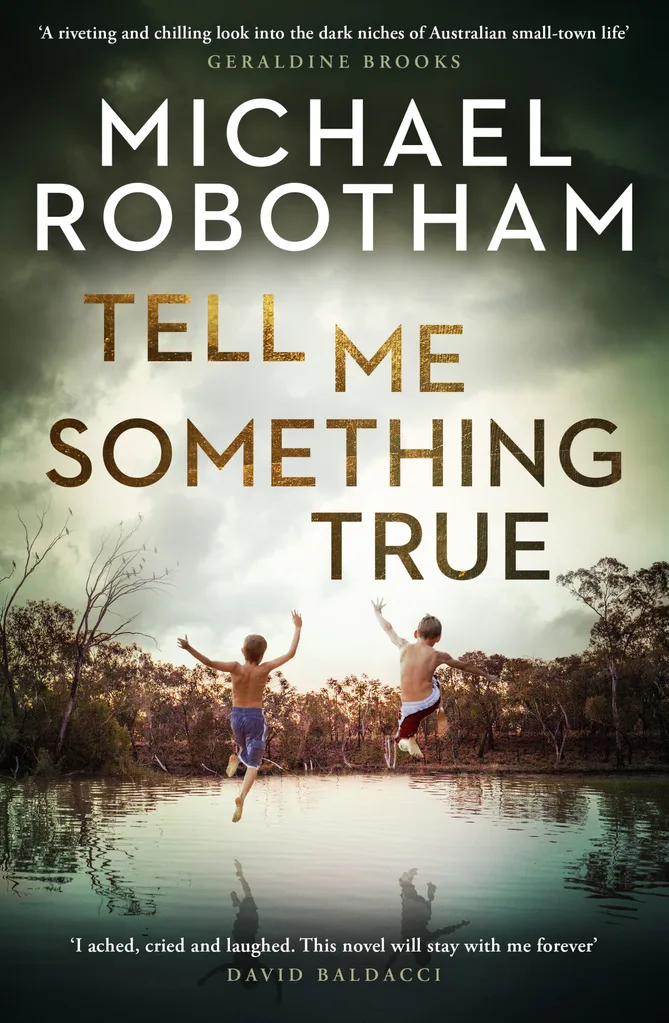
No, the early responses have been amazing. Even my American publisher contacted me last week. Stephen King sent an email and said how amazing he thought Tell Me Something True was. And my American publisher said, “I’ve never known a book get this must love from other writers”. The most astonishing people like Karin Slaughter and David Baldacci and Michael Connelly, they’ve all written how much they love this book. So hopefully Australians feel the same way.
Tell Me Something True begins with your protagonist, Arlo, returning to his small town after 12 years in prison. You’ve spoken about Yulara being based on where you grew up. Did you go back there when you were writing the book?
I did. The real town is Gundagai, but I’ve called it something else because I don’t want anyone in Gundagai playing some guessing game and thinking I’ve based the characters on real people, because they’re all fictitious. I’ve changed the street names, but they’re all the places in the town and the history is all the same.
I went back down there on a research trip and my old Catholic primary school is now a boutique hotel. I slept in the convent building where the nuns used to sleep that taught me.
And I went to the local library to look at the copies of the Gundagai Independent because I wanted to get some flavour for the years the book is set in, 1988 and 2001. The librarian looked at me and said, “You’re Michael Robotham”. That was very sweet, although then I had to swear her to secrecy because I had visions of half the town turning up wanting to be in my book. I don’t know whether they’re going to invite me back. I don’t know whether, having read the book, I’ll ever be allowed back into Gundagai.
Was there something about Australian small towns that appealed to you for the story you were trying to tell?
The simple answer is I grew up in small towns. When I went for my first job interview at Fairfax when I was 17 years old for a cadetship, I’d never been in a lift before by myself and I’d never been on an escalator. I was a complete hayseed. My parents didn’t have even have a phone at home. Here I was trying to get a job for a major newspaper.
So I knew country towns well. I know that they’re this strange mixture: they are full of secrets and yet they are places where it’s impossible to keep a secret because everybody knows everybody’s business … and they have long, long memories and they do not forgive easily.
And this is important because Arlo Hackett, he’s leaving prison, he’s coming back to a town where a terrible crime happened, and he is being held responsible for that crime. And the more the town try to force him out, the more he begins to question what really happened all those years ago. I think the intolerance of small towns and the conservatism shows. Because he’s a hunted man, and there are very few people there that would even give him the time of day.
Was that something you were like looking to explore when you wrote this book?
Yes, particularly the long memories. I only lived in Gundagai until I was 12, but about a dozen years ago I did an event in Wagga … which is about 50 miles from Gundagai. And I told a story about this event in Gundagai where I lit a little campfire in our back paddock and the first house that it threatened belonged to the head of the Gundagai Rural Fire Brigade because, you know, typical little kid lights a little fire and it suddenly gets out of control. I was probably six years old when it happened. There was an intake of breath and there were a dozen people that had travelled from Gundagai to come to this literary lunch and they remembered that fire … They have long, long memories, small towns. They really do.
It sounds like you have some good memories of the small town as well.
There’s a scene in the book where Arlo is recounting a childhood scene where he races the school bus home from school. He tries to beat the school bus and he’s running over this mountain which is pockmarked with old gold mine shafts that have been filled in, and the ground opens up underneath him and he almost falls into a shaft, and he looks down and there are eyes peering up at him. And that happened to me. I raced the school bus home as a kid and we rescued a dog from down a mine shaft. So it’s a special book for me because there are those little nuggets of my own life in there.
Do you remember if it was the story that came to you first, or the characters?
It was the characters. The most important characters, Arlo, and his brother Luke, who is a gentle giant. In this day and age we’d say he was autistic, but back in the 1980s they just referred to it as failing to thrive or being a little slow on the uptake.
I liked the idea of dropping into this family unit, this absolutely out-of-control teenage girl, Saxon, who is just feisty and opinionated and foul-mouthed, who arrives in the story driving a stolen car. You just know she’s going to be this rock dropped into this still pond, that she’s going to send ripples. And that was always there in the story, that idea of Saxon. That she would infuriate people and they would all fall in love with her.
She was very captivating on the page. There’s a big cast of characters in this book. Was there a particular one you enjoyed writing the most?
I do love writing feisty characters, maybe because I raised three feisty young women … I just adore writing them. I loved writing Saxon.
And I loved writing Helen. We meet Helen when she’s a school kid. And in that era, there was always the kid who came to school wearing hand-me-down clothes or the wrong shoes or not the right socks, and had a really terrible school lunch. They were poor, basically. They were dirt poor and people often made fun of them. And I based that Helen character on a girl I remember at school, who I wish I’d treated a lot better. I don’t think I mistreated her, but I think I just ignored her, and there should have been someone there that reached out and didn’t ignore her.
But I think some of that is youth, right? I think Arlo is a good example of that, when he’s younger, with his brother.
He’d [Arlo] spent his life looking after his younger brother and at times that infuriated him because his younger brother was this third wheel that would get in the way when Arlo wanted to chat to girls or drink with his mates. He was always having to look after his slower younger brother. And at times he was quite cruel. But I don’t think there’s any doubt he loved him. He loved Luke. But we do say cruel things to people we love, sadly.
I think you portray that love between the brothers very well in this story. Was there something about brotherhood that you were looking to explore?
I began writing this before I was a crime writer … so I didn’t see it as a crime novel and even now I don’t see it as a crime novel.
I know there’s a central mystery at the heart of it, what happened 12 years ago. But to me it’s more a story of brotherhood and it’s a love story and it’s a coming-of-age story and it’s the story of small towns.
You don’t often plot your books before you write, you just see where the story takes you. But because this one had been with you for so long, was that different in this case?
Initially when I wrote it, I wrote it chronologically. The way people will read it now, there are the two time frames. There’s Arlo getting out of prison in 2001 and he flashes back to 1988 and all the events that led to him going to prison. Initially when I wrote it, I just wrote it in a single time frame from 1988 and I carried forward. It was a little bit more concertina-ed and it had a slightly different ending, but in pretty much stayed the same.
It was odd for me because I knew what was going to happen in this one. So it was more about what I would take from the old book. You’ve got to remember it was literally just a pile of pages. I had to put them into my computer and type them up because they were they were just typewritten pages in a folder. Then it was a case of deciding what I kept and what I didn’t.
There are certain things I wanted to change … I wanted to have Arlo older and coming back rather than the way town reacted to him at the time and reacted to the events at the time. I wanted him older and coming back and seeing if there was any sense of forgiveness in the town, any sense that they accepted the fact that he wasn’t responsible. But he pleaded guilty because he felt he was, he felt as though he could have stopped this crime happening, so therefore he bore some responsibility for what happened.
You dedicated this book “for all of those who have a manuscript sitting in their bottom drawer”. What advice or motivation would you offer an aspiring author who is in that position?
There are two things I’d say. One is never throw anything away because there’s a reason why you wrote that and it might only be a character in it that you can use later on. And often, even if it’s a very good novel, it’s not your first one that gets published first. A lot of people’s third novels [will] get published first and their first novel gets published third. It’s almost as though publishers want to know, having discovered a new talent, what else have you got in your bottom drawer?
But the biggest advice is if you really want to be a writer, don’t give up after one … because the whole point is you write because you love writing. And so if there’s one in your bottom drawer, fine. It might always stay there. But write another one and another one and another one. It’s the only way to get better.
Can readers expect more Australian-set novels from you in the future?
I can tell you it won’t be another 20 books before I do it again! What’s amazing is when I dragged out the original folder [of Tell Me Something True] I found a whole lot of ideas and things that I had started back then as well. And I suddenly thought, “There might be something in there”.
But the next novel, the one I’m finishing now, is going to be another Philomena McCarthy book. She’s the young London policewoman who’s defied the odds because she comes from a family of notorious gangsters. There’s big news coming on the TV front on that one very soon. I can’t tell you yet, but there’s big news coming.
Then I’ve got an idea for another Australian novel. Watch this space.
Read the book review here.

We seek out the best stories. We nurture them. Then we share them. Hachette Australia is a team of expert publishers and passionate readers dedicated to discovering and supporting talented writers and working with them to craft exceptional stories.

Related stories
Book Review: Tell Me Something True by Michael Robotham
Native ad body.
Book Review: The Burn by Jessica Mansour-Nahra
Native ad body.
Book Club: The Burn by Jessica Mansour-Nahra

Native ad body.
Book Club: Sophie Green, author of The Frock Shop
Book Review: The Frock Shop by Sophie Green