



At a glance…
- Yayoi Kusama, the famed Japanese artist, has died aged 97.
- To celebrate the Yayoi Kusama exhibition coming to the National Gallery of Victoria International in Melbourne in 2025, we’re revisiting our feature about the iconic artist from our January issue of that year.
She was a friend of Georgia O’Keeffe, a rival of Andy Warhol, and she outlived them both to become one of the most celebrated artists of our time. Welcome to the brilliant, infinite, abstract world of Yayoi Kusama.
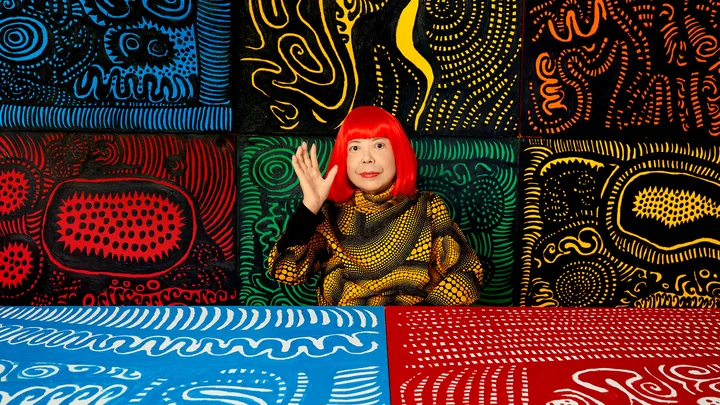
It was a frigid January day in Paris when Louis Vuitton’s store on the Avenue des Champs-Élysées was conquered by a King Kong-sized woman wearing a polka-dot dress and a bright red bob. The inflatable avatar of Yayoi Kusama was part of a brand collaboration between the luxury label and the 95-year-old Japanese artist. It was also
a surreal culmination of Yayoi’s lifelong campaign for fame. The caricature’s face was set in a stern expression, conveying the iron will that sustained Yayoi during
the years she was impoverished, pilloried, dismissed and erased, before finally becoming the most successful living female artist on Earth.
Yayoi Kusama has lived a radical life. More than four decades of it have been spent, voluntarily, in a psychiatric hospital. There were lean, desperate years in New York, where she jostled for gallery space with pop art giants Andy Warhol and Claes Oldenburg. A woman and a foreigner, she lost these battles, but her devotion to her craft earned the concession from The New York Times that she “might be the greatest artist to come out of the 1960s”.
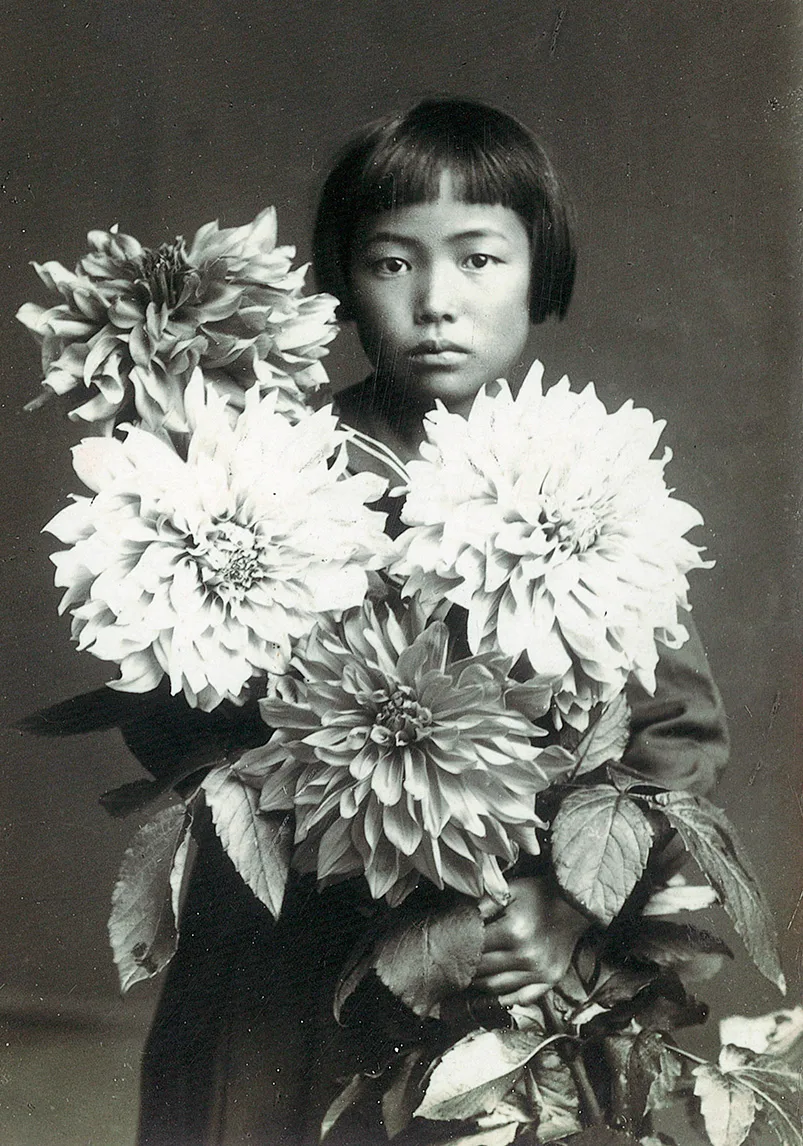
Yayoi’s art is partly inspired by vivid hallucinations she’s had since she was young.
“I kept dreaming these dreams, thinking how desperately I wanted to be rich and muttering to myself that fame would not be bad either,” she wrote in her autobiography, Infinity Net. “My constant battle with art began when I was still a child.”
Yayoi was born in Matsumoto in 1929 to a wealthy family whose nurseries sold flowers and seeds. Her father was a philanderer, and her mother, Shigeru, would send young Yayoi to spy on him, then take her rage out on her children. Yayoi would flee to the flower fields with her sketchbook.
It was in these fields that she had the first of the hallucinations that would continue throughout her life.
“I had thought that only humans could speak, so I was surprised the violets were using words,” Yayoi says in the documentary, Kusama: Infinity. Her family did not support her creative ambitions. Shigeru would tear Yayoi’s paintings and drawings.
Longing to escape her oppressive life, Yayoi wrote to the president of France. “Dear Sir, I would like to see your country, France. Please help me.”
In reply, she received a package of documents about cultural exchange programs. “But, oh, what headaches that infernal language gave me,” Yayoi opined. She settled instead on America. After finding a book of Georgia O’Keeffe’s art, she took a six-hour train to the American embassy in Tokyo, where she located the painter’s address in a catalogue of notable Americans. Yayoi wrote to O’Keeffe, sending some watercolours and asking for her advice.
O’Keeffe, then one of the most famous female artists in the world, wrote back, igniting a friendship that would sustain Yayoi through the tough early years of her career. Yayoi arrived in New York in 1957 with a few hundred dollars stitched into her dress and 60 kimonos she hoped to sell to survive. She describes the city as a living hell.
“It was a war every day,” she said in 1998. Her bed was a door she found on the footpath, and she only had one blanket. She sometimes went days without food. “I froze to the bone,” Yayoi wrote. “Unable to sleep, I would get out of bed and paint. There was no other way to endure the cold and the hunger. And so I pushed myself on to ever
more intense work.”
One day, Georgia O’Keeffe came to Yayoi’s studio. She made the decision to introduce Yayoi to her art dealer, Edith Halpert, who purchased one of Yayoi’s paintings for her gallery. Yayoi took every cent she had and bought more art supplies.
“I painted and painted. I set up a canvas so big that I needed a stepladder to work on it, and over the jet-black surface I inscribed to my heart’s content a toneless net of tiny white arcs, tens of thousands of them,” she recalled in Infinity Net.
Those paintings featured in Yayoi’s first solo New York exhibition in 1959. The New York Times called the show a “tour de force”. Other critics praised it as “stunning”, “quietly overwhelming” and “the sensation of the season”.
She was anointed a rising star. Her work evolved to encompass soft sculpture created from fabric, stuffing and thread. Sculptor Claes Oldenburg, who has become famous for producing sagging, soft, large-scale renderings of everyday objects, was emerging at this time. Yayoi writes that when she displayed her soft works, Oldenburg was
working with stiff papier-mâché. When Claes later exhibited soft sculptures, his then-wife Patty Mucha took Yayoi aside and said, “Yayoi, forgive us!”
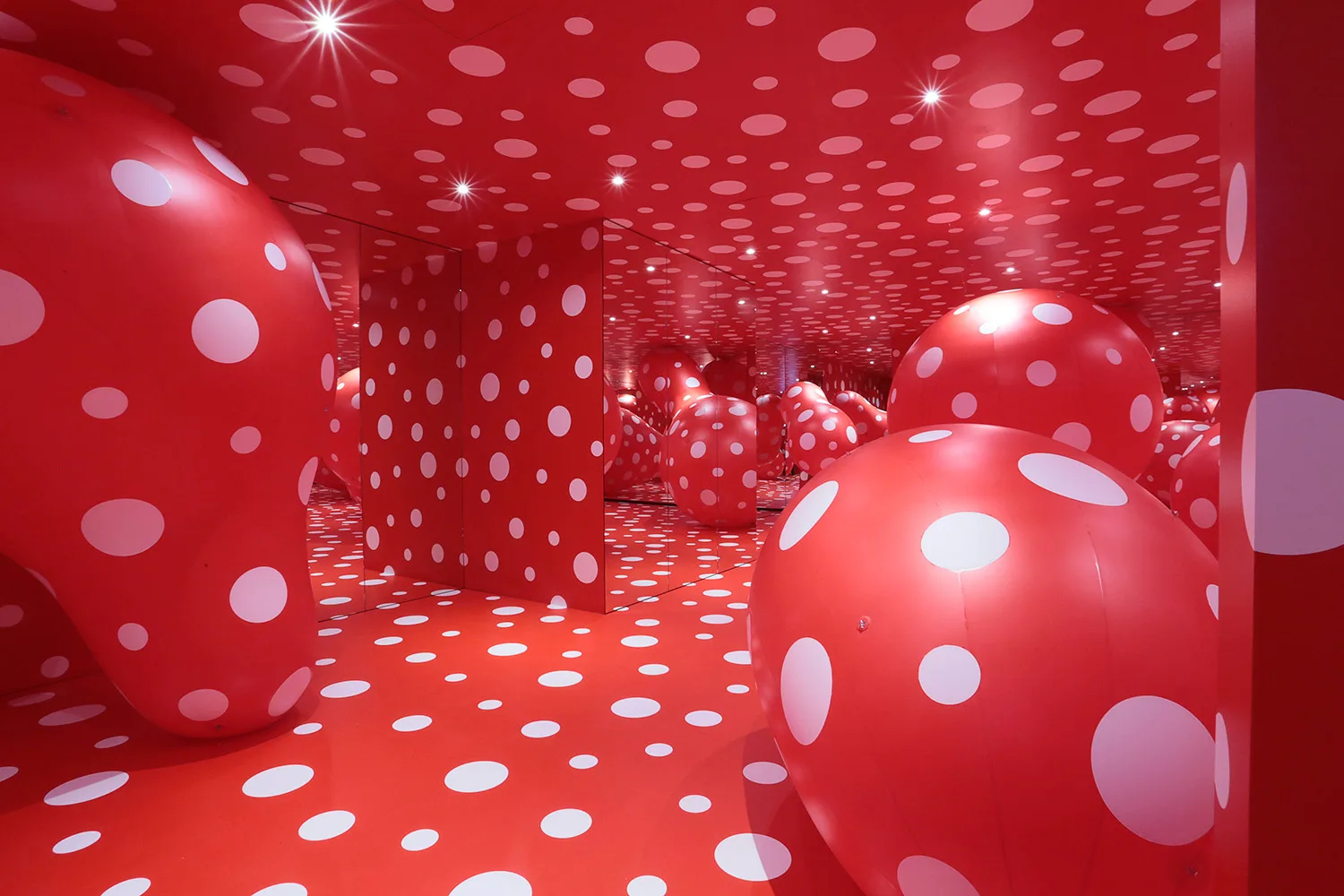
In 1965, Yayoi unveiled her large-scale work Infinity Mirror Room – Phalli’s Field, in which mirrored walls infinitely reflected a floor covered in soft sculptures decorated with red spots. A few months later, artist Lucas Samaras exhibited a mirrored room installation at a more prestigious gallery in New York.
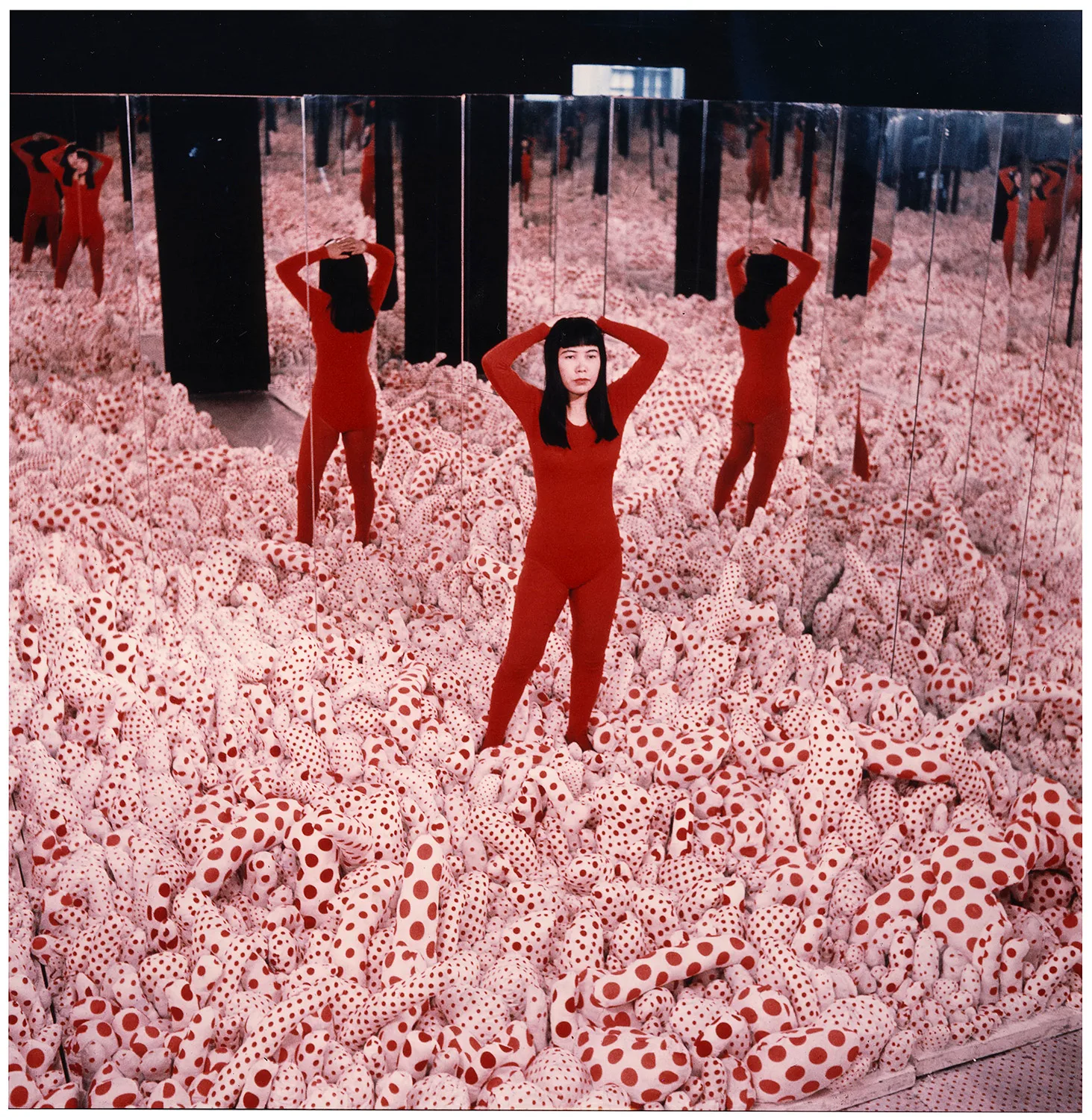
The repeated erasure of Yayoi’s art sent her into a depressive spiral. Shortly after the mirror room incident, she threw herself out a window. It might have been fatal had a bicycle not broken her fall. She recovered, and in 1966 Yayoi took herself to the Venice Biennale. There she sold large silver balls from her work Narcissus Garden
to passers-by. The act was a comment on the commercialisation of art.
However, Yayoi had not been invited to the Biennale, and organisers shut down her performance.
In the 1970s, Yayoi returned to Japan, and shortly after, checked herself into a psychiatric hospital where the doctors used art therapy. The world began to forget about Yayoi Kusama, but in the confines of the hospital, she was painting, painting, painting.
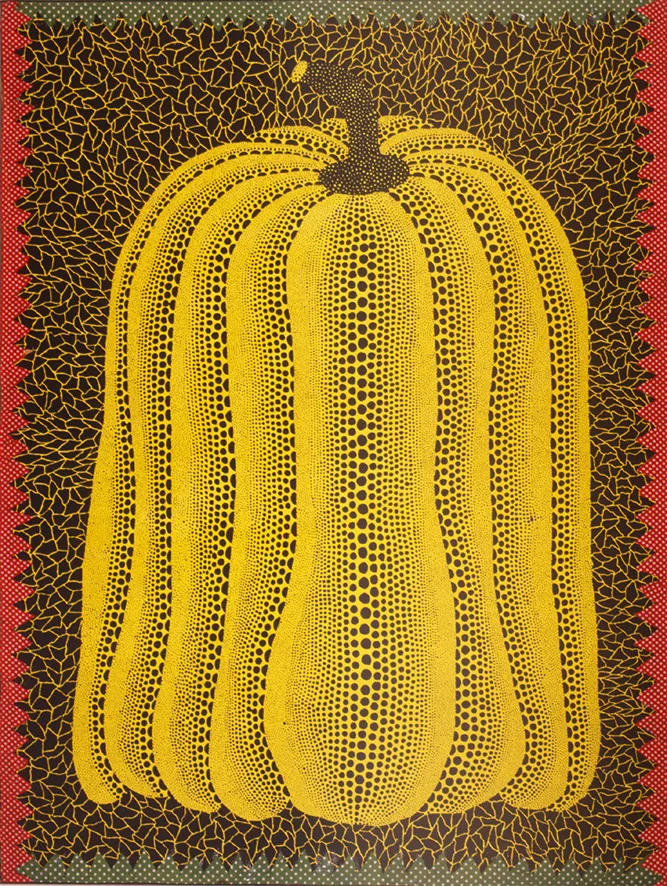
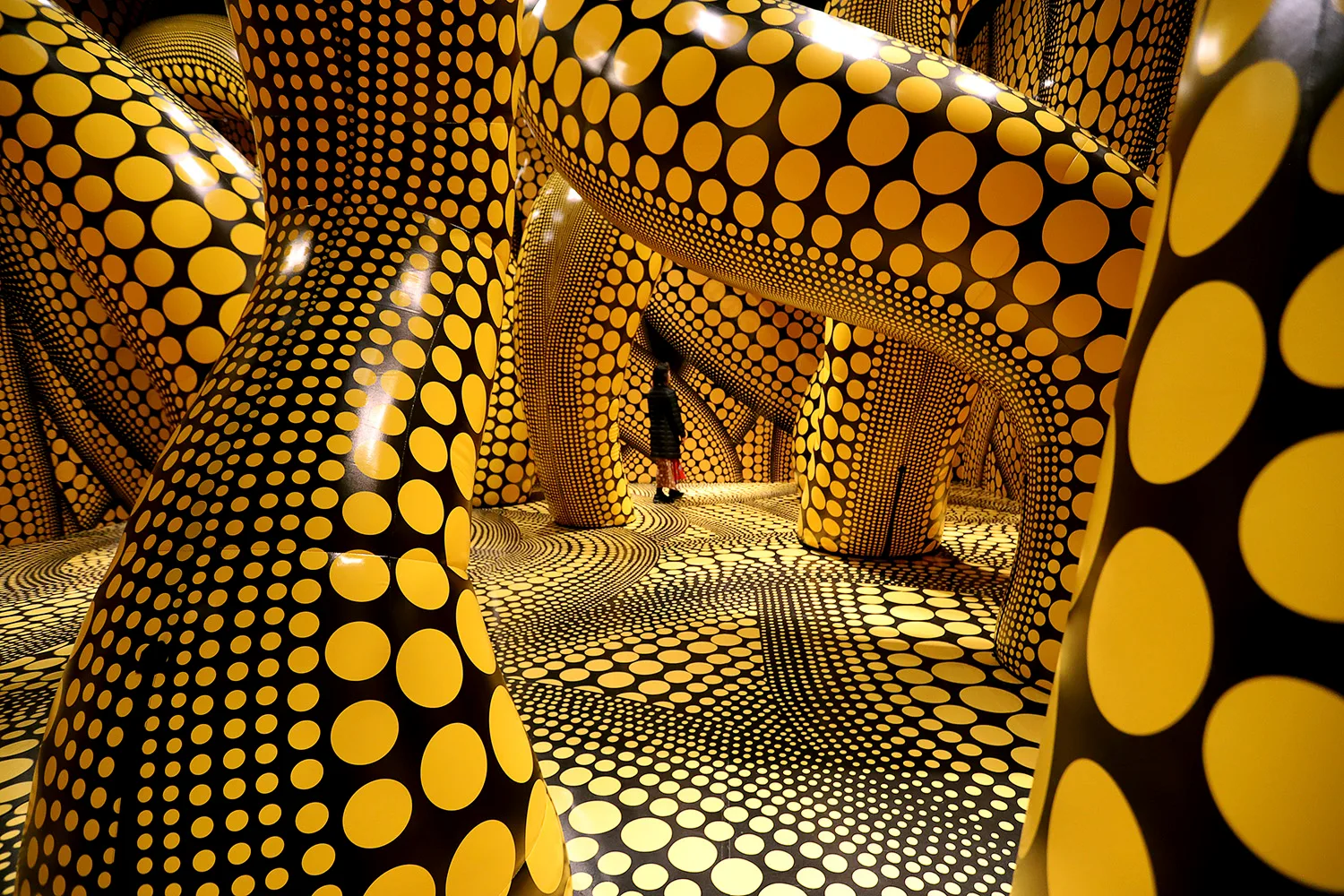
A retrospective of her work at New York’s Centre for International Contemporary Arts in 1989 revived interest in Yayoi’s singular vision, and in 1993 she was invited to represent Japan at the Venice Biennale. Her infinity room of mirrored walls reflecting pumpkins decorated in spots began a revival that would grow to become a feverish global obsession.
In 2017, she opened her own five-storey museum in Tokyo. By then she’d had major solo exhibitions in Rio, Seoul, Mexico City, London, Los Angeles, Washington and Chile. Her exhibitions attract huge crowds. Many galleries limit visitors’ time in her mirror rooms to 30 seconds.
In Australia, her works have been featured in most major institutions. The National Gallery of Australia in Canberra holds one of Yayoi’s famous infinity rooms in the national collection. At the Art Gallery of NSW, Flowers that Bloom in the Cosmos, a giant polka dot flower sculpture, stands tall on the terrace of the Naala Badu building.
Yayoi has achieved the rare status of being both critically acclaimed and wildly popular, and she has become, according to former Tate Modern curator Frances Morris, “a celebrity artist of our era”.
Now, a lifetime of Yayoi’s work will be on display at the National Gallery of Victoria (NGV). The exhibit will include blockbuster items such as the Australian premiere
of Dancing Pumpkin, a 5m-tall bronze sculpture, and a new presentation of her Narcissus Garden concept that was banned from the 1966 Venice Biennale.
“There are few artists working today with the global presence of Yayoi Kusama,” says Tony Ellwood, director of the NGV. Yayoi worked closely with the NGV to help them
bring their vision of a 200-work exhibit to life. “Without the artist’s personal dedication to this exhibition, and excitement to share her worldview with Australian audiences, none of this would be possible,” Tony adds.
Yayoi rarely grants interviews, and reportedly has little interest in the wealth that follows fame. In 2023 she told The Art Newspaper that she intends to “continue creating a world in awe of life”.
The reclusive artist remains in Tokyo, shuffling between her psychiatric hospital home and her studio, painting, painting, always painting.
This article originally appeared in the January 2025 issue of The Australian Women’s Weekly. Subscribe so you never miss an issue.

Related stories

Native ad body.

Native ad body.

Native ad body.