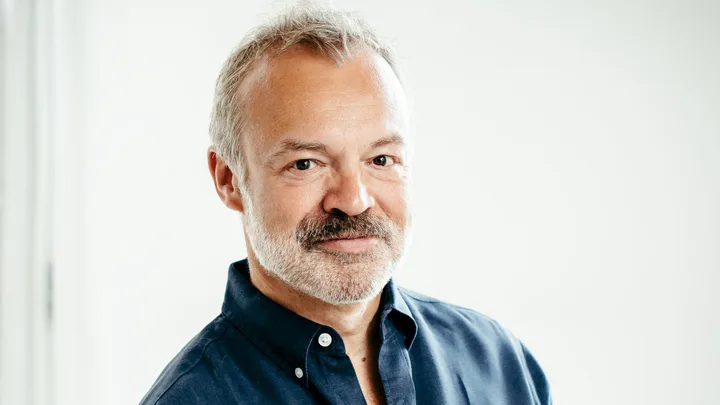
AWW: Your novel Forever Home was inspired by a comment a woman made to you about packing up her home. She said, “This is the second house I’ve packed up this year.” Was there a similar encounter that sparked Frankie?
Graham Norton: Not really. This book came about for a variety of reasons. I was toying with two very different ideas but wasn’t sure that either of them was enough to carry the full weight of a novel. At the same time I was thinking about plot and the greatest one of all, which we all experience, the story of a life. I suddenly realised that if I followed the journey of one woman’s life it might be possible to encompass both of the ideas I had been considering. Of course, once I started, Frankie’s story became so much more than that.
What about the character, Frankie, herself, how did she come to you? Is she inspired by someone – or several people – in your life, or an anecdote you heard?
Quite a few of my novels involve an older Irish woman and people often ask me if they are based on my own mother. They’re not, but I would say they are mum adjacent. That notion of the Irish Mammy is a well-known one but the older women I know have a steeliness to them. They are the children of a world recovering from a global conflict, and that gives them not just the grit of survivors but also an impatience with anything they might consider indulgent. They show their love by deeds rather than declarations. Frankie is cut from that cloth. She has learned cruelly early in life that happiness is not to be trusted.
You once said, “I wanted people to be able to read the books and forget that Graham Norton off the telly wrote them”? Do you have a ritual that helps you shift gears from high-energy celebrity interviews to the intimacy of two people sharing tea and toast in a terrace in Wapping?
In a way I think it is a bigger gear shift to become the high energy tv host! That is the person most people know but I think the man who writes these books is much closer to the real me, certainly the sixty-year-old version of me!

When you write a novel, do you plan it out beforehand or do you start and see where the kernel of an idea takes you?
In an ideal world I have the basic shape of the story mapped out before I began the actual writing but sometimes time or inspiration, often both, work against that so you begin with large parts of the map obscured. On a good day that is wonderful when all sorts of unexpected things happen and the story twists in ways you could never have envisaged, but on bad days it can be wildly disheartening. So much of story telling is getting from A to B, but that is very difficult to do if you still don’t know what or where B is. Details of Frankie’s story changed and the plot evolved but I think this book is the closest to the one I set out to write. I think of it as looking the most like the picture in the recipe when I finally took it out of the oven.
I heard you got some fantastic writing advice from the wonderful author of One Day, David Nicholls, about having a structure before you begin. Have you received any other writing advice that you have carried with you as you’ve developed as a novelist?
Writers have been so generous and encouraging to me, in a way I’m not sure I’d be to a novelist who suddenly announced they were going to be a chat show host! Apart form David’s wise words about structure the best thing about talking to professional writers is discovering that your experience of writing a novel is not unique. Everyone goes through a phase of thinking no one will want to read the book, everyone wants to give up, everyone wants to make endless changes after it is too late. It doesn’t make the agony any better, but it is a comfort to have company.
Parts of Frankie are set in Ireland. You depict small town life with vivid affection. One line that sticks out is the path to the alluring John O’Sullivan’s house, which is described as a “narrow lane became a dirt track with a mohawk of grass running down the centre.” Did you return to Ireland to create these chapters, or have you built the world from memory?
Have you been to Ireland? Trust me, there are many dirt tracks with a mohawk of grass! I spend as much time back in Ireland as I can. This would come as a huge surprise to the twenty-year-old me who left never intending to return. I find age somehow increasing the lure of home, and I feel more myself in Ireland than anywhere else. At the same time London has been my actual home since the eighties, so when I began writing these novels, it was the Irish readers I was most worried about. What if I got it wrong, or the Ireland I was writing about didn’t ring true? They weren’t going to buy the books out of politeness. Happily the novels have been really well received in Ireland which is the best compliment I could ever receive.
Frankie traverses decades and continents. Did her story require much formal research, or were you drawing on your own life and experiences and the stories of people in your life?
It was more a case of Frankie’s life intersecting with worlds I was interested in but wanted to know more about, so the research was a pleasure rather than a chore. The real challenge is to try and use all the new found knowledge with a light touch. There is such a temptation to pack the the story with facts and weird coincidences that you’ve discovered but the focus has to remain on the fictional characters and their journey. I remember chatting to an author who wrote proper historical fiction and I wondered about the huge amount of research she had to do. She happily told me “Not much. It’s just horses and candles.” I admire her approach!
You came to novel writing in your 50s after a successful career as an actor, stand-up comedian and host. What did you learn in those careers that has helped you as a novelist?
When I was much younger, as an English student at university in Ireland I tried to write fiction but of course didn’t have the self discipline to keep myself out of the pub. Now I’m so glad that I waited because I think my younger self would have written very glib, cynical stories. Age hopefully brings with it an empathy and understanding that makes for kinder stories and more sympathetic characters. As for what all my various jobs have taught me about writing, I suppose the thing that all of them have in common is storytelling and trying to hold an audience. If I manage to do that with my novels I consider them a success.
Buy Frankie here and read our book review here.

We seek out the best stories. We nurture them. Then we share them. Hachette Australia is a team of expert publishers and passionate readers dedicated to discovering and supporting talented writers and working with them to craft exceptional stories.

Related stories
Native ad body.
Native ad body.
Book Review: Tell Me Something True by Michael Robotham
Book Club: Tell Me Something True by Michael Robotham
Book Review: The Burn by Jessica Mansour-Nahra
Native ad body.
Book Club: The Burn by Jessica Mansour-Nahra