




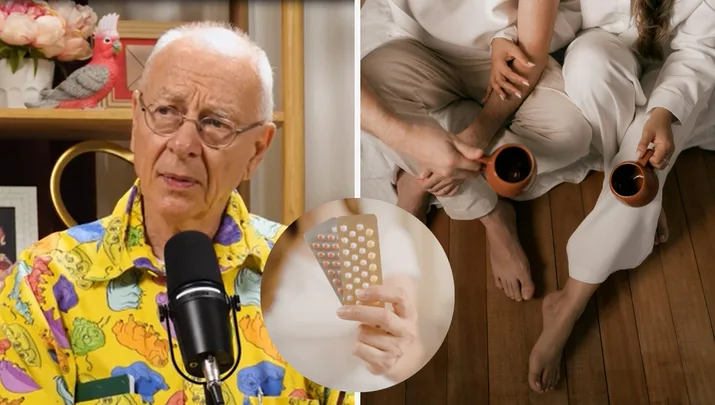
It sounds like the plot of a romantic comedy: woman meets man, falls in love, decides to start a family — and then, the moment she comes off the contraceptive pill, attraction changes and she looks at him and thinks, who on earth is this person? Except, according to Dr Karl Kruszelnicki — Australia’s beloved science communicator and guest on the Australian Women’s Weekly Love Stories podcast — this scenario is very real, and it comes down to something as primal as smell.
“She goes off the pill,” Dr Karl told Love Stories host Tiffany Dunk. “Suddenly she doesn’t like — ‘Who is this strange smelling man?'”
It’s a jarring idea. But the science behind it is both fascinating and well-documented, and it has everything to do with how our immune systems communicate through scent.
How does the contraceptive pill affect attraction?
The pill works by mimicking pregnancy in the body. And during pregnancy, a woman’s scent preferences shift — research suggests she becomes drawn to the smell of men with similar immune systems, likely because those genetically familiar people would have been the safest, most reliable support network for a vulnerable mother and newborn.
When a woman is not pregnant — and not on the pill — the preference reverses. She tends to be attracted to the scent of men with different immune systems to her own, because from an evolutionary standpoint, pairing with a genetically diverse partner means children inherit a broader, more robust immune defence.
The problem is straightforward: if you meet your partner while on hormonal contraception, your scent-based attraction may have been calibrated as if you were pregnant. When you come off the pill, your preferences can shift back — and suddenly, something feels different.
What is the vomeronasal organ and why does it matter?
Dr Karl explained that humans actually have two distinct smell systems at work in attraction. The first is the familiar olfactory epithelium — roughly one million cells high in the nose that process the scents we consciously register. The second is the vomeronasal organ, which responds to chemical signals including pheromones, but operates largely below our conscious awareness.
“We can smell either consciously with the olfactory epithelium… and then separately from that we’ve got something called the vomeronasal gland which gives off electricity when chemicals land on us,” Dr Karl explained on the podcast. “But we don’t know where they go in humans.”
It’s this deeper, unconscious system that’s thought to be most involved in pheromone-driven attraction — and most sensitive to the chemical shifts that hormonal contraception can cause.

The famous ‘sweaty t-shirt’ studies
Some of the most compelling evidence for scent-based attraction comes from a series of studies in which men wore the same white t-shirt for two consecutive nights without deodorant, then offered the shirts to women to smell and rate for attractiveness. Women consistently preferred the shirts of men with immune profiles different from their own — unless they were taking the contraceptive pill, in which case that preference often reversed.
“That’s based on studies with men wearing various t-shirts,” Dr Karl noted, with characteristic understatement.
There’s also research into menstrual cycle synchronisation — older studies suggested women living in close proximity synchronise their cycles through chemical signals, likely released from the armpits. Dr Karl notes this finding has been “slightly pulled back” from its original strength, but it points to the same truth: our bodies are communicating chemically in ways we barely understand.
“If you’re going to have contraception you should really go for rubber rather than chemicals, because you might end up getting attracted by the smell of the wrong person.”
Should you change your contraception method because of this?
Dr Karl’s advice on the matter is direct: “If you’re going to have contraception you should really go for rubber rather than chemicals, because you might end up getting attracted by the smell of the wrong person if that smell is an important factor.”
That said, scent is just one thread in a complex web of attraction. Most relationships are built on far more than chemistry alone — shared values, emotional connection, and genuine compatibility all play significant roles. The science doesn’t suggest your relationship isn’t real or your love isn’t valid. It’s simply a reminder that our biology is working quietly in the background, influencing more than we realise.
If you’ve noticed something shift since changing contraceptive methods, it may be worth a conversation with your GP — and, separately, with your partner.
Frequently asked questions
Does the contraceptive pill really affect who you’re attracted to?
Research suggests it can. The pill mimics pregnancy, which shifts a woman’s scent preferences from partners with different immune systems (the non-pregnant preference) to those with similar immune systems (the pregnant preference). This can influence who feels attractive, particularly on a subconscious, smell-based level.
What happens to attraction when you come off the pill?
When hormonal contraception is stopped, scent preferences may shift back to the non-pregnant baseline — meaning someone who smelled appealing while you were on the pill may smell noticeably different, or less appealing, once you stop. This effect varies between individuals and is one of many factors in attraction.
What is pheromone attraction and is it real in humans?
Pheromones are chemical signals that influence behaviour and attraction in animals. In humans, the evidence is less clear-cut, but research into the vomeronasal organ and immune-system-based scent preferences suggests chemical signalling does play a role in human attraction, even if we’re not consciously aware of it.
Can smell affect your relationship?
Yes — scent is one of the most primal senses and plays a role in subconscious attraction. Studies suggest people are often drawn to the natural scent of partners with complementary immune systems. Hormonal changes — from contraception, pregnancy, or other causes — can influence these scent-based preferences.


Related stories

Native ad body.

Native ad body.




Native ad body.